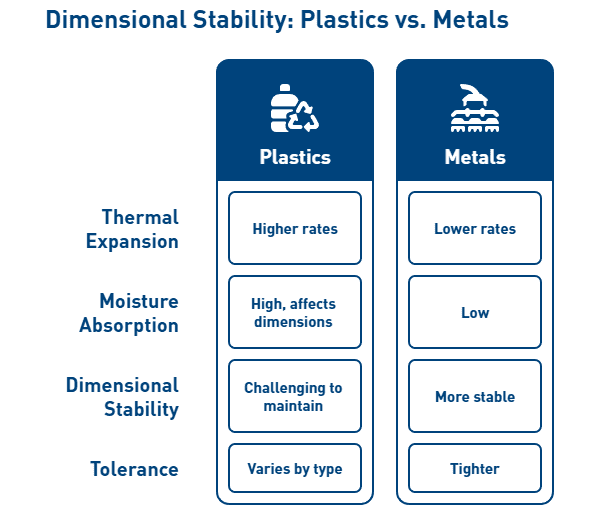
Drawings of plastic parts often specify tolerances that are tighter than the practical limitations for dimensionally stable plastics. Unlike metals, plastics present unique engineering challenges due to their higher thermal expansion rates, moisture absorption properties, and residual stress behaviors that significantly impact dimensional stability. For instance, nylon can absorb moisture at an extreme rate, with test specimens showing an 8.8% increase in mass and a 2% increase in length at saturation. The dimensional stability of plastics is particularly critical in applications requiring precise fit and consistent dimensions, as even minor variations can compromise functionality.

Consequently, understanding the factors affecting dimensional stability becomes essential for engineers working with precision plastic components. Temperature fluctuations cause different expansion rates in plastics compared to metals, with materials like UHMW exhibiting a coefficient of thermal expansion of .0001/inch/degree, resulting in movement of .012″ per degree of temperature change in a 10′ piece. Additionally, water absorption varies significantly between plastic types, with some engineering plastics swelling when exposed to humidity, further affecting dimensional accuracy. While some materials like Acetal can maintain tight tolerances of +/-.001 on most dimensions, others require more generous allowances, with industry guidelines recommending minimum machining tolerances of 0.2% of the nominal value. This article explores the critical considerations for achieving and maintaining dimensional stability in plastic parts across various environmental conditions and applications.
 

Thermal Expansion and Its Role in Dimensional Drift

Thermal expansion represents one of the primary challenges when designing dimensionally stable plastics components. Most plastic materials expand and contract at rates three to ten times greater than metals when subjected to temperature changes. This fundamental property affects both the design and functional performance of precision plastic components throughout their lifecycle.


CTE Comparison: Plastics vs Metals

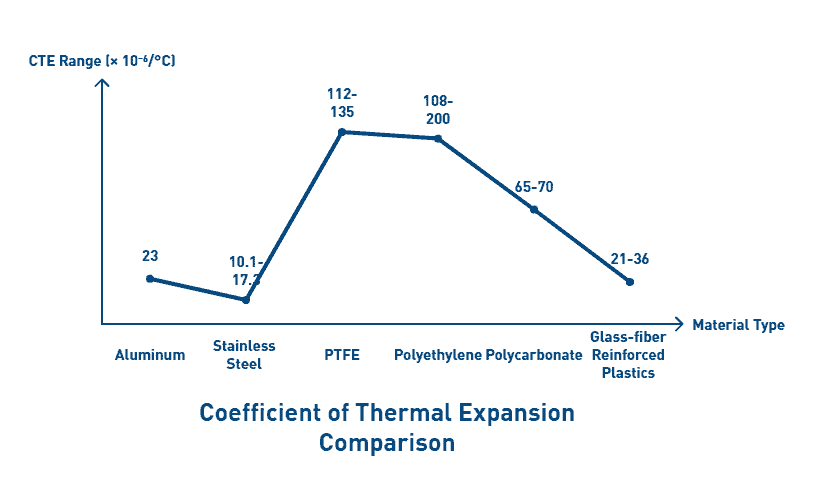
The Coefficient of Thermal Expansion (CTE) measures the dimensional change of a material per degree of temperature change. Generally, common metals like aluminum exhibit CTEs around 23 × 10⁻⁶/°C, while stainless steel ranges from 10.1 to 17.3 × 10⁻⁶/°C. In contrast, engineering plastics show significantly higher values:

  • PTFE: 112-135 × 10⁻⁶/°C
  • Polyethylene: 108-200 × 10⁻⁶/°C
  • Polycarbonate: 65-70 × 10⁻⁶/°C
  • Glass-fiber reinforced plastics: 21-36 × 10⁻⁶/°C
These differences become especially problematic in applications where plastic parts interface with metal components. Even though plastic parts may maintain tight tolerances during manufacturing, dimensional drift occurs as environmental temperatures fluctuate.


Temperature-Dependent Expansion in PEEK and PTFE

High-performance polymers like PEEK and PTFE demonstrate complex thermal expansion behaviors. Studies analyzing these materials up to 240°C show that their expansion characteristics are temperature-dependent. Importantly, the thermal diffusivity of composite materials containing PTFE/PEEK matrices is governed primarily by the polymer rather than reinforcing materials. Furthermore, adding carbon fibers enhances thermal stability at room temperature (25°C).


Design Revisions for Thermal Mismatch in Assemblies

When plastic components must interface with other materials, engineers should specifically account for expansion differences. If dimensional change from thermal expansion is constrained, excessive tensile, shear, or compressive stress can develop in the plastic part, potentially causing premature failure.

Two design approaches exist for addressing thermal expansion mismatches between materials. First, selecting adhesives with CTEs similar to the joined materials; second, employing more flexible materials to compensate for the differences. Moreover, for applications requiring enhanced dimensional stability, reinforcing thermoplastics with glass fibers or other fillers effectively reduces thermal expansion rates while improving mechanical properties.


Moisture Absorption and Humidity-Induced Swelling

Unlike thermal expansion, moisture absorption presents a distinct challenge for dimensionally stable plastics in humid environments. Moisture absorption is defined as a material’s capacity to absorb water from its surroundings, causing volumetric expansion and potentially altering mechanical properties.


Water Uptake in Nylon 6 and Dimensional Impact

Nylon’s exceptional water absorption capabilities make it a textbook example of humidity-induced dimensional changes. At room temperature under normal atmospheric conditions (35-65% relative humidity), unfilled nylon equilibrates at approximately 1.5-2% moisture content by weight. However, when fully immersed, this value increases dramatically to 5-8%. This absorption significantly impacts dimensions—a nylon 6 test specimen immersed in water exhibited an 8.8% increase in mass and a 2% increase in length at saturation.

Water molecules force polymer chains apart through hydrogen bonding, creating volumetric expansion. For unfilled nylon 6 or nylon 6/6, this typically results in dimensional growth of 0.5-0.6% at room temperature. At higher temperatures, both absorption rates and dimensional changes increase proportionally. Although glass fiber reinforcement can reduce these dimensional shifts to approximately 0.1% per inch of part dimension, even highly filled nylon will still expand by about 0.001 inch per inch.


Saturation Timeframes and Long-Term Effects

The time required to reach moisture saturation varies significantly based on material thickness and environmental conditions. For a 60mm diameter × 3mm thick disk of nylon 6, reaching 80% of equilibrium absorption takes approximately 330 hours in 20°C water, while achieving the same level in atmospheric conditions (20°C, 60% RH) requires about 4,110 hours. Full saturation typically takes 2.5 times longer.

For thicker components, saturation times increase exponentially. A 20mm thick cast nylon 6 piece requires approximately 15.6 years to fully saturate when continuously submerged in water at ambient temperature. After 10 months of constant submersion, the same material shows saturation depth of only 2.3mm.


Material Selection for Low Water Absorption

When dimensional stability is critical, engineers should select materials with minimal moisture absorption. Polytetrafluoroethylene (PTFE) stands alone as the only polymer exhibiting zero water absorption. Other materials with very low absorption rates include PEEK, PPS, PSU, PPSU, PEI, PVDF, PET, PPE, PP, and PE. Furthermore, acetal, PA12, PC, and ABS demonstrate relatively low absorption characteristics.

For applications requiring dimensional precision, the rule of thumb suggests that expansion due to moisture absorption must be considered for wall thicknesses up to 5mm, sometimes for thicknesses between 5-10mm, but generally not for thicknesses exceeding 10mm. Nevertheless, even materials typically regarded as dimensionally stable can exhibit surprising dimensional responses in close-tolerance assemblies.


Residual Stress, Creep, and Post-Molding Shrinkage

Residual stress, creep, and post-molding shrinkage present persistent challenges for maintaining dimensionally stable plastics throughout their service life. Despite often being overlooked in design considerations, these factors critically influence both short and long-term performance of precision plastic components.


Stress from Extrusion and Machining Operations

Residual stress develops when polymer molecules cannot achieve their preferred orientation during manufacturing processes. Previously ignored because of difficulty in quantification, these internal stresses significantly impact part performance through dimensional instability, optical distortion, and reduced mechanical properties. Extrusion operations create non-uniform stress profiles, with studies showing a linear correlation between residual stress and temperature differences at pipe walls. Similarly, machining introduces stress through several mechanisms: frictional heat generation at tool contact points, improper cutting tool design, and excessive cutting speeds that cause localized overheating. Notably, tight clamping during machining transfers stress to the workpiece, potentially causing warpage once released.


Annealing Techniques for Stress Relief

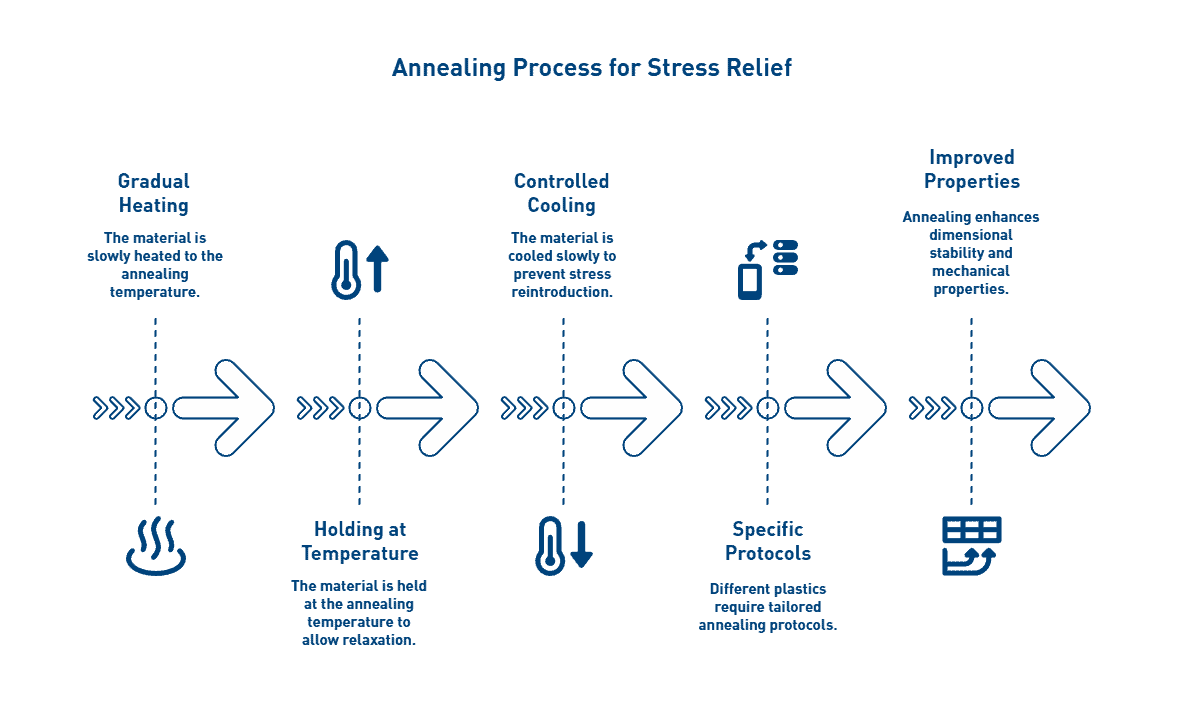
Annealing effectively eliminates internal stresses through controlled heating below a material’s glass transition temperature. The process involves three critical phases: gradual heating to the designated temperature (typically one-third to half of the melting point), holding at that temperature to allow polymer chains to relax, and controlled cooling to prevent reintroducing stress. For optimal results, different plastics require specific annealing protocols—polycarbonate at 250°F (121°C) for minimal time, Ultem at 400°F (204°C) for two hours, and super resins at 400°F (204°C) for four hours. Essentially, annealing improves dimensional stability, enhances mechanical properties, reduces stress cracking, and increases chemical resistance.
 

Creep Strain from Improper Storage

Creep—the permanent deformation of material under static load over time—occurs notably in dimensionally stable plastics stored improperly. Subsequently, plastic parts change shape and exceed tolerance limits when subjected to mechanical loads during extended storage periods. The creep process advances through distinct stages: immediate strain upon first exposure, followed by steady-state deformation, and ultimately rapid progression before failure. Unlike metals, plastics change properties substantially with time under constant pressure and temperature. One documented example showed PVC extrusions improperly stacked during summer months that permanently deformed.


Post-Molding Shrinkage in Acetal and Polypropylene

Semi-crystalline polymers with glass transition temperatures below room temperature continue to shrink significantly after molding. Indeed, acetal homopolymer parts measuring within specifications immediately after production showed continued shrinkage of approximately 0.004 inches after just 24 hours. This phenomenon occurs because materials like polypropylene (Tg between -10°C and +15°C) and acetal (Tg of -78°C) remain above their glass transition temperature at room conditions, allowing continued crystallization. The resulting post-molding shrinkage can reach approximately 0.001 inch/inch in properly molded acetal parts. Furthermore, studies tracking properties over five weeks post-molding revealed increasing tensile strength and modulus alongside decreasing impact performance—all direct results of continued crystallization.


Best Practices for Tolerancing in CNC Machined Plastics

Achieving optimal tolerances in CNC machined plastics requires specialized techniques and material-specific considerations that differ substantially from metal machining processes. Accordingly, manufacturers must adapt their approaches to accommodate the unique properties of dimensionally stable plastics.


Plastic Machining Tolerances by Material Type

Material selection critically influences achievable tolerances in plastic machining operations. Acetal materials demonstrate excellent stability, permitting tolerances as tight as +/-.001″ on most dimensions. Meanwhile, PEEK components can maintain similar precision at +/-.001″. In contrast, nylon requires more generous allowances at +/-.002″, whereas softer materials like UHMW necessitate even broader tolerances of +/-.005″ due to their heightened thermal sensitivity. For close-tolerance applications, PEEK or POM (acetal) combined with controlled fixturing and temperature regulation can achieve exceptionally tight tolerances of ±0.01 mm.


Rough Machining and Relaxation Periods

Internal stress release represents a primary challenge when pursuing dimensionally stable plastics through machining. Initially, performing rough machining followed by a deliberate relaxation period allows internal stresses to dissipate prior to finishing operations. In some cases where tight tolerances must be achieved, plastic parts should be machined to a rough shape and allowed to relax for several days. Afterward, an annealing step before final machining further reduces stress levels. This approach proves particularly valuable for components with significant material removal.


Fixturing Techniques to Minimize Stress

Proper workholding fundamentally affects dimensional outcomes. Excessive clamping introduces residual stress that subsequently causes warpage once released. To counteract this, consider using double-sided adhesive tapes to secure plastic stock shapes, as tapes introduce minimal stress compared to mechanical clamping. Another effective approach involves clamping only sections of stock that will not become part of the finished component. For flexible materials like polypropylene, providing additional support for thin-walled sections prevents vibration and deflection.


Precision Plastic Components for Aerospace and Medical

Aerospace and medical applications demand exceptional dimensional precision in plastic components. In these fields, quality control, tight tolerances, and engineered materials all play critical roles in reducing customer risk. For aerospace applications, high-performance dimensionally stable plastics offer lightweight alternatives that improve fuel efficiency. Medical devices benefit from precisely machined plastic components that enhance fluid flow and device performance. The stringent requirements of these industries necessitate temperature-controlled manufacturing environments and frequently incorporate micro-molding techniques for extremely complex geometries with tolerances as tight as 0.015″.


Conclusion

Dimensional stability represents the cornerstone of successful plastic component design and manufacturing. Throughout this article, the complex interplay between material properties and environmental factors has demonstrated why achieving tight tolerance plastic parts requires specialized knowledge and techniques. Thermal expansion differences between plastics and metals, sometimes 3-10 times greater, necessitate careful material selection and design considerations, particularly for assemblies combining different materials. Moisture absorption further complicates matters, with materials like nylon exhibiting significant dimensional changes while alternatives such as PTFE, PEEK, and acetal offer superior stability in humid environments.

Residual stress management proves equally critical for dimensionally stable plastics. Proper annealing techniques, controlled machining operations, and appropriate fixturing all contribute significantly to maintaining dimensional accuracy. Consequently, engineers must consider not only initial tolerances but also long-term dimensional stability throughout a component’s service life.

Material selection ultimately determines the achievable tolerances for precision plastic components. Acetal and PEEK generally permit tolerances as tight as ±0.001 inches, while softer materials like UHMW require more generous allowances. Though achieving tight plastic machining tolerances presents challenges, specialized techniques such as rough machining followed by relaxation periods substantially improve results.

Advanced applications in aerospace and medical fields demand exceptional precision and reliability from plastic components. Engineers working in these sectors should work with their manufacturing partners to receive a tolerance assessment and learn how they can ensure dimensional stability in every machined plastic part. Additionally, quality control processes must account for temperature fluctuations, moisture effects, and stress relaxation to maintain dimensional accuracy over time.

Looking for a manufacturing partner that understands how to keep tight tolerances? Get a Quote or Request a Consultation with AIP Precision Machining today.


FAQs

Q1. What factors affect the dimensional stability of plastic parts?
The main factors affecting dimensional stability of plastic parts are thermal expansion, moisture absorption, and residual stress. These can cause dimensional changes in plastic components over time and in different environmental conditions.


Q2. How does thermal expansion impact plastic parts compared to metal components?
Plastic materials typically expand and contract at rates 3-10 times greater than metals when subjected to temperature changes. This can lead to dimensional drift and potential issues in assemblies where plastic and metal components interface.


Q3. Which plastic materials offer the best dimensional stability in humid environments?
Materials with low moisture absorption rates like PTFE, PEEK, PPS, and acetal offer better dimensional stability in humid environments. PTFE stands out as the only polymer exhibiting zero water absorption.


Q4. What is annealing and how does it improve dimensional stability in plastic parts?
Annealing is a heat treatment process that eliminates internal stresses in plastic parts. It involves controlled heating below the material’s glass transition temperature, holding at that temperature, and then cooling slowly. This process improves dimensional stability, enhances mechanical properties, and reduces stress cracking.


Q5. What are the best practices for achieving tight tolerances in CNC machined plastic parts?
Best practices include selecting appropriate materials (e.g., acetal or PEEK for tighter tolerances), using rough machining followed by relaxation periods, employing proper fixturing techniques to minimize stress, and considering temperature-controlled manufacturing environments for precision components.


Follow AIP Precision Machining on Linkedin

linkedin logo

The global surgical robots market, valued at $3.92 billion, is estimated to reach $7.42 billion by 2030. Precision machined components for orthopedic navigation devices serve as the foundation for this rapidly expanding field, enabling surgeons to achieve remarkable levels of accuracy during complex procedures.

Robotic systems are transforming orthopedic surgery by facilitating new approaches. These advanced navigation systems combine cutting-edge technologies and provide real-time guidance during surgeries, significantly enhancing a surgeon’s ability to perform complex maneuvers with exceptional precision. Specifically, in minimally invasive surgery-transforaminal interbody fusion procedures, orthopedic surgical robots enhance accuracy compared to traditional freehand techniques, with a 2021 review showing robotic accuracy ranging from 94.6% to 99%. These impressive results highlight why precision machined components play such a critical role in the development and functionality of orthopedic navigation devices that continue to advance surgical capabilities.


Precision Machining Techniques for Orthopedic Navigation Systems

Modern orthopedic navigation technology requires manufacturing techniques that can consistently deliver components meeting the highest standards.


Multi-axis CNC Milling for Surgical Navigation Housings

Advanced 5-axis CNC milling represents a crucial innovation for navigation system housings, enabling the creation of complex geometries that would be impossible with traditional methods. Unlike standard 3-axis machining, 5-axis capability adds two rotational axes that allow for complex contours and multi-surface machining in a single setup. This technology proves essential for navigation housings that must precisely contain sensors while maintaining biocompatibility and sterilizability. Moreover, these systems can achieve exceptional dimensional accuracy—often within ±0.002 mm—crucial for components that interface with human anatomy.


Live Tooling for Complex PSU and PPSU Geometries

Live tooling technology enhances the capabilities of CNC lathes, enabling milling operations on the same machine—ideal for producing small, complex orthopedic components with high precision. For PPSU (polyphenylsulfone) components commonly used in navigation instruments, this approach proves particularly valuable. PPSU materials are selected specifically when repeated steam sterilization is required, necessitating specialized machining strategies that preserve the material’s beneficial properties. Consequently, this integrated approach reduces setups and maintains tighter tolerances.


Surface Finishing for Biocompatible Thermoplastics

Surface quality directly impacts biocompatibility in medical components. Key aspects affecting biocompatibility include surface roughness, surface features, chemistry, crystallinity, and porosity. For navigation systems, finishing techniques create surfaces that minimize bacterial colonization while optimizing sensor function. Indeed, skilled machining centers can achieve surface roughness readings as low as Ra < 0.02 μm, essential for articulating surfaces and device interfaces.


Tolerancing Requirements for Navigation-Grade Components

Navigation systems demand exceptionally tight tolerances to ensure accurate positioning on patient anatomy. For critical interfaces and alignment features, typical tolerance targets range from ±0.02–0.05 mm, depending on material properties. Profile tolerancing, rather than linear dimensioning, often provides advantages in quality control for complex navigation components, reducing inspection time while maintaining precision. This approach addresses the unique challenges of thermoplastic components that must interface precisely with both sensors and surgical instrumentation.


High-Performance Polymers in Navigation-Enabled Devices

High-performance polymers form the backbone of modern orthopedic navigation systems, offering unique properties that enhance surgical precision and patient outcomes. These advanced materials enable the creation of lightweight, durable, and functionally superior components essential for navigation-enabled devices.

ULTEM™ Machined Parts for Radiolucent Applications

ULTEM™ (polyetherimide or PEI) stands out as an exceptional material for navigation components requiring transparency to imaging technologies. This amber-colored polymer combines high strength and rigidity at elevated temperatures with exceptional dimensional stability. Most importantly, ULTEM™ retains 100% of its tensile strength even after 2,000 steam autoclave cycles at 270°F, making it ideal for reusable navigation instruments. The polymer’s inherent radiolucency allows unobstructed visualization during image-guided procedures, a critical requirement for orthopedic navigation. For applications demanding additional rigidity, glass-filled ULTEM™ versions provide enhanced dimensional stability while maintaining the material’s valuable radiolucent properties.


PEEK and CFR-PEEK in Sensor-Compatible Housings

PEEK (polyetheretherketone) and its carbon-fiber-reinforced variant (CFR-PEEK) have revolutionized sensor housing design in navigation systems. These materials offer mechanical properties remarkably similar to cortical bone, thereby reducing stress shielding. Their radiolucency enables clear post-operative imaging without interference, a crucial advantage over metal components. Notably, PEEK-based materials have been implanted in approximately 15 million devices worldwide with zero material-related recalls, demonstrating exceptional reliability. Additionally, CFR-PEEK can support directly printed sensors on its matrix, creating new possibilities for designing sensor functions targeting different orthopedic applications.


PPSU for Sterilizable Surgical Navigation Tools

Polyphenylsulfone (PPSU) delivers superior performance among sulfone polymers for navigation instruments that require repeated sterilization. This high-performance material offers impact strength similar to polycarbonate but with enhanced chemical resistance and operating temperatures around 200°C (392°F). PPSU maintains its mechanical properties through 800 sterilization cycles and shows no significant discoloration even after 1,000 cycles. For enhanced visibility during procedures, specialized PPSU variants like TECASON P MT XRO incorporate contrast media that enable clear visualization under fluoroscopy and X-ray, making it ideal for orthopedic navigation tools.


Polymer Replacement for Metal in Orthopedic Robotics

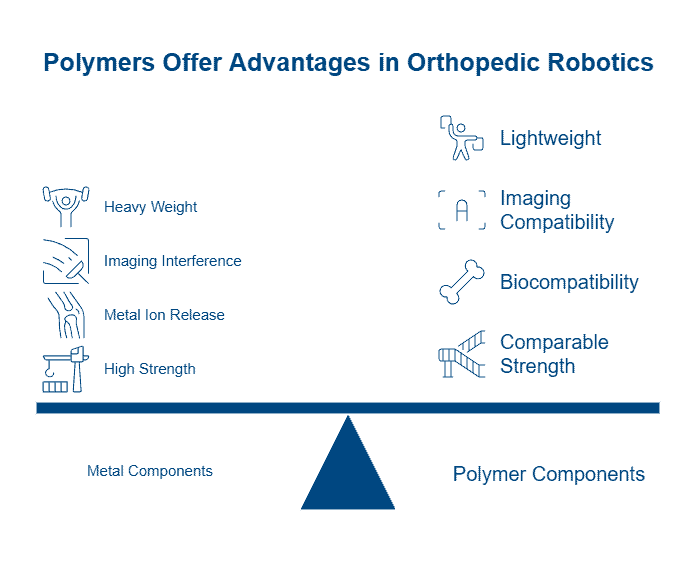
High-performance polymers increasingly replace metals in robotic orthopedic applications, offering several advantages:

  • Weight reduction: Components can be up to 70% lighter than traditional metal versions
  • Imaging compatibility: Radiotransparent polymers allow unobstructed intraoperative visualization
  • Biocompatibility: Materials avoid metal ion release that can cause osteolysis
  • Mechanical performance: Advanced polymers maintain strength comparable to metals

In robotic surgical systems, these polymers are used in mechanical arms, connections between tools, and housings. Specialty polymers like PPSU, PEEK, and reinforced PARA compounds enable greater design freedom while withstanding harsh cleaning environments necessary for surgical applications.


Quality and Compliance in Precision Polymer Machining

Quality management serves as the cornerstone for manufacturers creating precision components for orthopedic navigation systems. Stringent standards ensure these critical devices perform safely and effectively in surgical settings.


ISO 13485 Certification for Navigation Component Manufacturing

ISO 13485 certification establishes a comprehensive quality management system specifically designed for medical device manufacturing. This internationally recognized standard requires detailed documentation of all manufacturing processes, from raw material inspection to final product testing. Essentially, certification demonstrates to regulators that manufacturers meet stringent requirements for safety and quality.


FDA-Compliant Plastic Parts for Surgical Use

Adherence to FDA regulations, including Title 21 CFR which outlines rules for medical devices, ensures plastic components meet necessary safety standards. Manufacturers must comply with quality system regulation (Part 820), establishment registration (Part 807), and unique device identification (Part 830). These requirements help maintain the highest levels of safety and efficacy in orthopedic navigation tools.


Traceability and Lot Control in Navigation Systems

Traceability enables tracking of components throughout their lifecycle—from procurement and use to sterilization and final disposition. Each implant requires a lot control identifier, allowing manufacturers to trace individual items during their transactional journey. This capability proves essential for ensuring safety, meeting compliance requirements, and enabling efficient recalls when needed.


Cleanroom Machining Standards for Implantable Devices

Cleanroom facilities maintain stringent cleanliness levels by controlling air pollutants such as dust, microbes, and particulates. Medical device manufacturing cleanrooms typically meet at least ISO-8 classification, with a maximum particle count of 100,000 per cubic foot. Proper HEPA filtration systems, controlled airflow, and strict protocols ensure component quality and patient safety.


Integration of Machined Components in Robotic Orthopedic Surgery

Robotic orthopedic surgery relies on precision machined components that seamlessly integrate with navigation systems for optimal performance. These components must function cohesively within complex assemblies to deliver the accuracy surgeons require.


Component Fitment in Robotic Arms and End Effectors

Robotic arms in orthopedic surgery provide unprecedented precision, allowing surgeons to perform complex procedures with enhanced control. The robotic components can rotate 360 degrees, offering range of motion beyond human capabilities. Critical to this functionality is the integration of precision-machined instruments with multiple articulating joints that mimic human finger movements. In settings where optical alignment faces line-of-sight blockages, inertial-guided surgical tools can supplement or replace optical guidance.


Precision Interfaces for Sensor Mounting in Navigation Tools

Inertial navigation systems incorporate Kalman filters—technology first used in Apollo moon missions—to merge data from multiple sensors, providing accurate location estimates. These systems help align artificial joints according to patient-specific characteristics. Properly calibrated sensor interfaces ensure that transition matrices between the robotic unit and CAD models align precisely with physical components. Subsequently, this precision helps counter surgeon hand tremor and fatigue.


Role of AIP Precision in Robotic Surgical Instrumentation

High-definition 3D visualization systems capture detailed images of surgical sites, enabling unparalleled accuracy. Hence, the precision components manufactured for these systems must maintain tolerances typically within 0.2mm. Robotic milling offers advantages over traditional CNC machining, primarily through reduced manufacturing time and costs.


Conclusion

Precision machined components serve as the foundation for advanced orthopedic navigation systems that continue to improve surgical outcomes. The integration of multi-axis CNC milling, live tooling, and specialized surface finishing techniques allows for components that meet the exacting tolerances required for navigation-grade applications.

Materials like ULTEM™, PEEK, CFR-PEEK, and PPSU offer significant advantages over traditional metals, including radiolucency, sterilizability, and mechanical properties that closely mimic biological structures. These characteristics make them ideal for sensor housings, navigation tools, and robotic components that must function flawlessly during critical procedures.

Quality management systems remain non-negotiable for manufacturers working in this space. ISO 13485 certification, FDA compliance, rigorous traceability protocols, and cleanroom manufacturing environments ensure components meet the highest standards for safety and effectiveness. Subsequently, these quality measures build confidence among surgeons and patients alike.

The future of orthopedic surgery will undoubtedly depend on continuous advancement in precision machined components. Robotic systems equipped with these components already demonstrate impressive accuracy rates exceeding 94% in complex procedures. Patients benefit from shorter recovery times, reduced complications, and improved long-term outcomes due to the precise alignment and placement these navigation systems facilitate.

Additionally, the shift toward high-performance polymers creates new possibilities for innovative designs that were previously impossible with traditional materials. Engineers can now develop lighter, more ergonomic tools that enhance surgeon control while maintaining the strength and durability necessary for repeated use.

This convergence of precision machining, advanced materials, and robotic technology represents a significant leap forward in orthopedic surgery. Though challenges remain in scaling production and reducing costs, the trajectory points toward increasingly sophisticated navigation systems becoming standard practice across a broader range of orthopedic procedures. Patients worldwide will ultimately benefit from the enhanced precision these machined components enable in the operating room.

At AIP Precision Machining, we specialize in delivering mission-critical components for orthopedic navigation systems that demand uncompromising accuracy, biocompatibility, and sterilization performance. Whether you’re developing next-generation robotic platforms or improving existing surgical instrumentation, our team offers ISO 13485-certified expertise in high-performance polymer machining to support your goals.

Contact us today to discuss how AIP can support your next orthopedic navigation project.


FAQs

Q1. What are precision machined components in orthopedic navigation?

Precision machined components in orthopedic navigation are highly accurate parts manufactured using advanced techniques like multi-axis CNC milling and live tooling. These components, often made from high-performance polymers, are crucial for creating surgical navigation systems that require exceptional dimensional accuracy and biocompatibility.


Q2. How do high-performance polymers benefit orthopedic navigation devices?

High-performance polymers like ULTEM™, PEEK, and PPSU offer numerous advantages in orthopedic navigation devices. They are radiolucent, allowing for clear imaging during procedures, can withstand repeated sterilization, and have mechanical properties similar to bone. These materials enable the creation of lightweight, durable, and functionally superior components essential for navigation-enabled devices.


Q3. What quality standards are important for manufacturing orthopedic navigation components?

Key quality standards for orthopedic navigation components include ISO 13485 certification, FDA compliance, and adherence to cleanroom machining standards. These ensure that components meet stringent safety and effectiveness requirements, maintain traceability throughout their lifecycle, and are manufactured in controlled environments to prevent contamination.


Q4. How are precision machined components integrated into robotic orthopedic surgery?

Precision machined components are integrated into robotic arms, end effectors, and navigation tools in orthopedic surgery. They enable the creation of complex articulating joints, precise sensor interfaces, and high-definition visualization systems. These components work together to provide surgeons with enhanced control and accuracy during procedures.


Q5. What are the benefits of using precision machined components in orthopedic navigation?

Using precision machined components in orthopedic navigation leads to improved surgical outcomes, including increased accuracy in bone cutting and component alignment, reduced operative time, and enhanced patient satisfaction. These components enable navigation systems to achieve remarkable levels of precision, with some studies showing accuracy rates exceeding 94% in complex procedures.

Follow AIP Precision Machining on Linkedin

linkedin logo

When aerospace applications demand exceptional performance under extreme conditions, engineers often find themselves choosing between two elite high-performance thermoplastics: Vespel® and Torlon®.

While Vespel® offers excellent thermal stability (Vespel® has the ability to maintain strength at temperatures up to 550 degrees Fahrenheit and withstand brief exposures to 900 degrees), chemical resistance, and dielectric strength, Torlon® provides even greater mechanical properties and load-bearing capabilities. In fact, both materials have carved out specialized roles in critical aerospace components, with Vespel® commonly used in electrical insulation and high-temperature bearings, while Torlon® excels in applications requiring exceptional stiffness and dimensional stability under heavy loads. The difference between these materials can significantly impact performance, reliability, and longevity of critical flight systems.

This article will examine the key distinctions between these remarkable polymers to help you determine which material best suits your aerospace application requirements.


Material Properties: Vespel® vs Torlon® at the Molecular Level

At the molecular level, Vespel® and Torlon® exhibit distinct chemical structures that directly influence their performance characteristics in aerospace applications.


Polyimide vs Polyamide-Imide Structure

Vespel® material consists of a polyimide (PI) composition with imide linkages that create exceptional thermal stability. Meanwhile, Torlon® is a polyamide-imide (PAI) thermoplastic, containing both amide and imide linkages alternating in its polymer chain. This molecular difference is fundamental – PAI combines the mechanical strength of polyamides with the thermal stability of polyimides, resulting in a hybrid material with unique properties.


Thermal Resistance: 550°F vs 500°F Continuous Use

Though closely matched, Vespel® demonstrates slightly superior thermal performance with continuous service temperatures up to 550°F (288°C). Consequently, it maintains structural integrity from cryogenic conditions to extreme heat. Torlon® offers impressive thermal resistance as well, with continuous use temperatures up to 500°F (260°C). Furthermore, Vespel® has no observable glass transition temperature below its decomposition point, which exceeds 752°F (400°C).


Moisture Absorption and Chemical Resistance

One notable difference between these materials appears in their moisture absorption characteristics. Torlon® exhibits a relatively higher moisture absorption rate compared to Vespel®. Nevertheless, both materials demonstrate exceptional resistance to chemicals, including acids, bases, and solvents. Torlon® particularly excels in resistance to aliphatic, aromatic, chlorinated, and fluorinated hydrocarbons.


Dielectric Strength and Electrical Insulation

Vespel® shows remarkable dielectric properties, with SP-1 grade offering 560 V/mil dielectric strength. Additionally, it maintains excellent electrical insulation even at high temperatures, making it particularly valuable for electronic aerospace assemblies.


Mechanical Strength: Tensile and Flexural Ratings

The mechanical properties of these materials reveal interesting contrasts. Torlon® 4435 demonstrates a tensile strength of 107 MPa (15.5 ksi), substantially higher than Vespel® SP-21’s 62 MPa (9.0 ksi). Similarly, Torlon®’s flexural modulus reaches 15.2 GPa (2.2 Msi), vastly exceeding Vespel® SP-21’s 3.2 GPa (0.5 Msi). However, Vespel® maintains its performance more consistently under extreme temperature variations.


Aerospace Applications: Where Each Material Excels

Beyond their molecular differences, Vespel® and Torlon® each shine in specific aerospace applications based on their unique performance attributes.

Vespel® Material Uses in Aerospace Bearings and Seals

Since 1965, Vespel® has outperformed other engineering materials under extreme conditions. Its combination of low wear, low friction, and impressive strength makes it ideal for aircraft engine bearings, bushings, washers, and seal rings. Notably, Vespel® SP-21 thrust bearings survive pressure-velocity conditions as high as 400,000 psi-ft/min. Moreover, Vespel® has proven especially effective in aircraft fan blade wear strips and blade spacers where strength and wear resistance are crucial. For spline couplings connecting metallic shafts, Vespel®’s elastic deformation properties redistribute loads more evenly, resulting in longer wear life.


Torlon® Properties in Aerospace Pump Housings and Valves

Torlon® sets benchmarks for reliability in aerospace components that require exceptional compressive strength. Specifically, aerospace bearings and bushings constructed from Torlon® maintain strict tolerance adherence under loads exceeding what traditional plastics can handle. Torlon®’s chemical resistance allows it to tolerate extended contact with phosphate ester fluids, jet fuels, hydraulic oils, and cleaning agents without swelling or cracking. This makes it particularly suitable for fluid management components, seals, manifold blocks, and check valves. Besides its strength, Torlon®’s flame-retardant qualities restrict combustion and suppress flame spread, even during direct exposure to ignition sources.


Performance in Cryogenic and Vacuum Environments

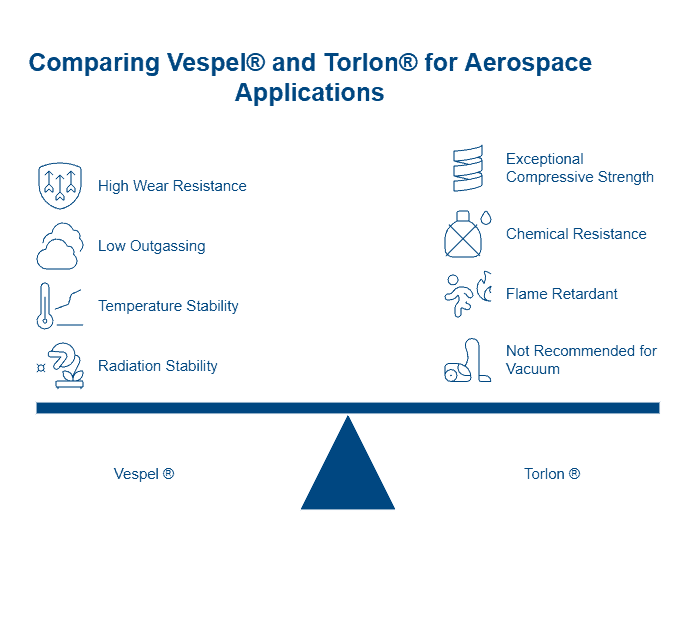
Vespel® maintains properties from cryogenic to high temperatures with exceptional dimensional stability. Essentially, Vespel® functions effectively in vacuum environments where it has replaced ceramic seals and gaskets in ultra-high vacuum conditions. According to the ASTM E595 standard developed by NASA, Vespel® exhibits low outgassing under vacuum. Conversely, Torlon® is not recommended for vacuum applications as it will “out-gas” and contaminate the environment.


Radiation and Outgassing Considerations

Radiation exposure tests show Torlon®-4203 samples experienced approximately 60 times higher wear compared to Vespel® SCP-5050 after high radiation exposure (10 Mrad). Indeed, Vespel® parts demonstrate excellent radiation stability with coefficient of friction, wear properties, and mechanical properties remaining nearly unchanged after exposure.


Tolerances for Aerospace Polymers

Precision engineering demands exacting standards for aerospace components, with tolerance capabilities directly influencing flight safety and performance. High-performance thermoplastics can maintain tolerances as tight as ±0.001″ when machined properly.

For optimal dimensional stability with Vespel® material, components should be rough-machined to within 0.015-0.020 inch of finished size, then equilibrated at 70°F and 50% relative humidity before final machining. Vespel®’s low and consistent thermal expansion coefficient allows for tight dimensional tolerances across various applications.

Remarkably, Torlon® maintains structural integrity even under extreme conditions. Despite rapid pressure fluctuations common in airframes, Torlon® consistently preserves its geometry without micro-cracking or creep. Its polyamide-imide structure effectively blocks heat-induced relaxation under load, thus preserving critical dimensions throughout entire mission timelines.

Surface finish specifications typically range from 16-64 RMS depending on application requirements. Machining strategies must account for material-specific thermal expansion characteristics to achieve precision results.

For difficult features like deep blind holes, special attention is required as these are challenging to manufacture to close tolerances. The depth of feed should not exceed 0.005 inch on first pass, gradually reducing to 0.002 inch per pass until completion. For extremely precise applications, parts may need machining and measuring in controlled environments.


Choosing the Right Material for Your Project

Selecting between Vespel® and Torlon® requires balancing specific performance needs against application constraints. Making this critical decision often depends on four key factors.


Torlon® vs Vespel® Wear Resistance in Moving Parts

Regarding wear resistance, both materials excel in different scenarios. Vespel® features excellent friction and wear characteristics, performing remarkably in high-wear applications without lubrication. Alternatively, Torlon® demonstrates exceptional toughness with superior mechanical resistance to high impacts and stress, providing dimensional stability that prevents premature wear. For bearings and high-motion components, Vespel® can withstand pressure-velocity conditions as high as 400,000 psi-ft/min.


Vespel® Thermal Stability in High-Heat Zones

Vespel® demonstrates superior thermal performance with continuous service temperatures up to 550°F, compared to Torlon®’s 500°F. Uniquely, Vespel® exhibits no observable glass transition temperature or abrupt softening point. Actually, Vespel® doesn’t melt at any temperature, allowing short-term exposure to temperatures as high as 900°F. NASA even selected Vespel® SP-211 for components exposed to temperatures reaching 750°F.


Cost, Availability, and Processing Time

Vespel® ranks among the most expensive engineering materials available. Although costly initially, both materials typically offer lower lifetime costs than specially treated metal components. Yet Torlon® presents machining challenges, requiring specialized tooling due to its extreme hardness.


Decision Matrix Based on Application Needs

Altogether, your selection should consider:

  • Vacuum requirements: Vespel® won’t outgas; Torlon® will contaminate vacuum environments
  • Moisture exposure: Vespel® has lower absorption
  • Mechanical needs: Torlon® for strength; Vespel® for wear resistance


Comparison Table

Property/Characteristic Vespel® Torlon®
Thermal Properties
Continuous Use Temperature 550°F (288°C) 500°F (260°C)
Brief Temperature Exposure Up to 900°F Not mentioned
Glass Transition No observable point below decomposition Not mentioned
Mechanical Properties
Tensile Strength 62 MPa (9.0 ksi) [SP-21] 107 MPa (15.5 ksi) [4435]
Flexural Modulus 3.2 GPa (0.5 Msi) [SP-21] 15.2 GPa (2.2 Msi)
Chemical/Environmental Properties
Moisture Absorption Lower absorption rate Higher absorption rate
Chemical Resistance Excellent resistance to chemicals Excellent resistance, especially to hydrocarbons
Vacuum Performance Low outgassing, suitable for vacuum Not recommended, will outgas
Electrical Properties
Dielectric Strength 560 V/mil [SP-1] Not mentioned
Application Strengths
Primary Applications – Electrical insulation
– High-temperature bearings
– Fan blade wear strips
– Spline couplings
– Pump housings
– Valves
– Heavy load applications
– Fluid management components
Performance Under Conditions
Radiation Resistance Excellent stability, properties remain unchanged Higher wear rate (60x more than Vespel® after exposure)
Load-Bearing Good Superior mechanical properties
Dimensional Stability Excellent across temperature ranges Excellent under heavy loads


Conclusion

Selecting the right high-performance polymer is a mission-critical decision in aerospace engineering. Vespel® and Torlon® each offer distinct advantages that can dramatically influence part longevity, system performance, and compliance with aerospace operating environments.

For applications exposed to extreme heat, radiation, or vacuum, Vespel® is unmatched in its thermal endurance, dielectric strength, and low outgassing behavior. Conversely, for components under continuous mechanical stress, pressure, and fluid exposure, Torlon® provides the strength and dimensional stability required to maintain integrity under demanding conditions.

At AIP Precision Machining, we partner directly with aerospace engineers and procurement leaders to guide material selection, prototyping, and ultra-precision machining of Vespel®, Torlon®, and other mission-critical polymers. With AS9100D and ISO 9001 certifications, our team ensures every component meets the strictest aerospace standards from initial design through final inspection.

Need help deciding between Vespel® and Torlon® for your next aerospace application?

Partner with the polymer machining experts at AIP Precision. Our engineering team provides:

  • – Application-specific material consulting
  • – DFM support for weight, tolerance, and thermal optimization
  • – Ultra-precision machining down to ±0.002 mm
  • – Certified compliance with AS9100D, ISO 9001, and ITAR

Request a consultation today or get a custom quote:  aipprecision.com/get-a-quote


FAQs

Q1. What are the main differences between Vespel® and Torlon® in aerospace applications?

Vespel® excels in thermal stability, with continuous use temperatures up to 550°F and brief exposures to 900°F. It’s ideal for high-temperature bearings and electrical insulation. Torlon®, on the other hand, offers superior mechanical strength and is better suited for heavy load applications like pump housings and valves, with continuous use temperatures up to 500°F.


Q2. How do Vespel® and Torlon® compare in terms of wear resistance?
Both materials offer excellent wear resistance, but in different scenarios. Vespel® performs remarkably in high-wear applications without lubrication, especially in bearings and high-motion components. Torlon® demonstrates exceptional toughness and superior mechanical resistance to high impacts and stress, providing dimensional stability that prevents premature wear.


Q3. Which material is better suited for vacuum environments?
Vespel® is the preferred choice for vacuum environments. It exhibits low outgassing properties and maintains its performance in ultra-high vacuum conditions. Torlon®, however, is not recommended for vacuum applications as it tends to outgas and can contaminate the environment.


Q4. How do these materials perform under radiation exposure?
Vespel® demonstrates excellent radiation stability, with its properties remaining nearly unchanged after exposure. In contrast, Torlon® samples have shown significantly higher wear rates (approximately 60 times higher) compared to Vespel® after high radiation exposure.


Q5. What are the cost considerations when choosing between Vespel® and Torlon®?
Vespel® is generally more expensive initially compared to other engineering materials. However, both Vespel® and Torlon® typically offer lower lifetime costs than specially treated metal components when used in appropriate applications. The choice between them should consider specific performance needs against application constraints and long-term cost-effectiveness.

Follow AIP Precision Machining on Linkedin

linkedin logo