
High-Performance Polymers for Defense Systems face some of the most demanding operational conditions imaginable, from extreme temperature swings between -65°F and 400°F to exposure to corrosive propellants and intense vibration loads. Traditional metals don’t deal very well with corrosion and weight constraints, but advanced polymer solutions have proven their value over decades of military service.
In this article, we’ll get into how mission-critical polymer components address harsh environment challenges. These include PEEK for defense systems, TORLON® PAI for defense applications, and ULTEM™ PEI defense components. We’ll address material selection frameworks that match polymer properties to specific defense requirements across weapons systems and aircraft, along with naval vessels and electronic applications.
Critical Environmental Stresses in Defense Operations
Extreme Temperature Variations (-65°F to 400°F)
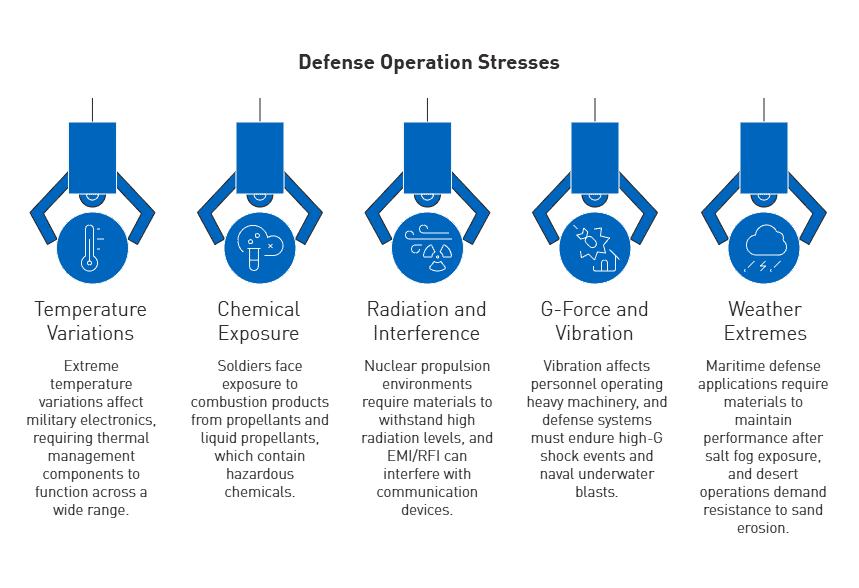
Military electronics must function across temperature ranges from arctic conditions at -65°C (-85°F) to propulsion environments exceeding 1100°C (2000°F). Defense thermal management components face aerospace application requirements spanning -65°C to +165°C, with rapid cycling that stresses material bonds and alters conductivity characteristics. Testing protocols confirm performance under extreme conditions. Validation procedures expose components to 150°F environments for eight hours, where torque requirements can vary by a lot based on thermal expansion. -40°F exposure testing reveals how materials respond to extreme cold at the opposite extreme. Break-away torque increases as lubricants stiffen and materials contract.
Chemical Exposure from Propellants and Fuels
Soldiers operating weapons systems face exposure to combustion products from propellants that liberate large volumes of gasses under high pressure and temperature faster. These energetic materials include primers and igniters, with propellants having three different chemical compositions that vary by weapon system. Liquid propellants present additional hazards. They contain chemicals such as hydrazine, monomethylhydrazine (MMH), and unsymmetrical dimethylhydrazine (UDMH) that react with atmospheric oxygen to produce formaldehyde derivatives, nitrogen, and water. The combustion of most propellants cannot be quenched once begun. This creates persistent chemical exposure challenges for polymer components in proximity to firing mechanisms.
Radiation and EMI/RFI Interference
Nuclear propulsion environments place unique demands on materials and require detailed testing at radiation exposure levels from 10³ to 10⁹ rads. Some plastic materials exhibit steep drops in mechanical properties under high radiation levels. They lose strength and ductility that indicates high probability of failure under stress or impact loads. Electromagnetic interference (EMI) and radio frequency interference (RFI) can interfere with communication devices, delay weapons systems deployment, and enable signal jamming. Materials must maintain EMI shielding integrity across environmental extremes while resisting degradation from aircraft fluids, hydraulic oils, and deicing solutions.
High G-Force and Vibration Loads
Vibration exposure affects personnel operating heavy machinery, pneumatic hand tools, and material handling devices through whole body vibration and segmental vibration. Defense systems must endure conditions from arctic temperatures and desert dust storms to high-G shock events and naval underwater blasts. MIL-STD-810H environmental testing covers vibration, mechanical shock, acceleration, and gunfire shock in a variety of operational environments.
Weather Extremes and Moisture Resistance
Maritime defense applications require materials to maintain specified performance after 3,000+ hours of salt fog exposure per MIL-STD-810H Method 509.7. High-altitude applications must perform in low-pressure environments, while desert operations demand resistance to sand erosion and UV exposure.
High-Performance Polymer Families for Mission-Critical Applications
PEEK for Defense Systems: Properties and Grades
Polyetheretherketone stands among the strongest thermoplastics available for mission-critical polymer components. PEEK maintains structural integrity where conventional materials fail with a glass transition temperature of 217°C (422°F) and continuous-use capability up to 260°C (500°F). Military specification MIL-P-46183 defines three main types: nonreinforced (Type I), glass fiber reinforced at 10%, 20%, and 30% content (Type II), and carbon fiber reinforced at 20% and 30% levels (Type III). So carbon fiber grades achieve tensile strengths reaching 185 MPa and maintain an oxygen index of 35% minimum for flame resistance.
TORLON® PAI for Defense Applications
Polyamide-imide delivers the highest strength of any unreinforced thermoplastic. Compressive strength doubles that of PEEK when unfilled and exceeds ULTEM PEI by 40%. TORLON maintains mechanical properties approaching polyimide performance levels and operates at temperatures above 232°C (450°F). The glass transition temperature reaches about 280°C (536°F) and enables use in jet engines, internal combustion applications, and thrust washers. Its very low coefficient of linear thermal expansion ensures dimensional stability that precision defense electronics require.
ULTEM™ PEI Defense Components
This amorphous polyetherimide offers glass transition temperatures of 217°C with thermal indices up to 180°C. ULTEM meets UL94 V0 specifications in sections as thin as 0.41 mm without additives and generates limiting oxygen index values of 47%. The material resists stress cracking when exposed to aircraft fluids, aliphatic hydrocarbons, and weak aqueous solutions. This makes it suitable for aerospace connectors and cable ducts. FAA regulation 25.853 compliance verifies its use in commercial aircraft interiors.
Ryton R-4 PPS for Chemical Resistance
Polyphenylene sulfide combines strength and chemical inertness with no known solvents below 200°C. Heat distortion temperature reaches 265°C. Room temperature stiffness exceeds glass-reinforced PEEK at lower cost. Oxygen index measurements show 44% flame resistance and suit plasma torch insulators and downhole connector applications in oil and gas environments.
Matching Material Properties to Defense System Requirements
Weapons Systems and Portable Missile Components
Precision accuracy in portable missile launchers demands materials that remain dimensionally stable under varying environmental conditions while resisting aggressive propellants and launch temperatures. Components such as radomes, igniter cups, and fins benefit from carbon and glass-fiber reinforced PEEK and TORLON PAI grades, which maintain dimensional tolerances comparable to metals through low coefficient of linear thermal expansion. Inherent flame resistance meets material specifications for weaponry exposed to propellant combustion, while the 40% weight reduction achieved with engineered nylons in ammunition casings improves soldier mobility without compromising ballistic performance.
Military Aircraft Components Under Thermal Stress
The F-16 fighter’s auxiliary fuel tank connects used stainless steel originally and created lightning strike hazards in wetted metal applications. Engineers specified Torlon 4203L machined from proprietary Seamless Tube® to replace metal components. The material can withstand jet fuel exposure, heavy vibrations, and temperature excursions to 400°F during afterburner flight. Every connect has passed the 650psi pressure test required for this application. Variable stator vane bushings and thrust reverser track liners use polyimide parts for low-friction, low-wear performance with chemical and heat resistance in smaller, lighter-weight actuators.
Naval Vessel Applications in Nuclear Environments
The American Composites Manufacturing Learning Center tested thermoplastics at exposure levels from 10³ to 10⁹ rads. Torlon 5030 PAI retained mechanical properties at 10⁹ rads, the highest assessment level for polymer materials, while PEEK also passed at this threshold. The US Navy specified Torlon PAI for ball valve and tube seats in nuclear submarines based on this radiation resistance.
Machined Plastic Components for Defense Electronics
Conductive plastic compounds blending stainless steel fibers with flame retardant ABS provide EMI/RFI shielding for defense electronics. Ryton R-4 PPS delivers electrical and thermal insulation properties for connectors and receptacles in naval vessels, while ULTEM PEI‘s resistance to stress cracking from aircraft fluids makes it suitable for terminal blocks and light housings.
Material Selection Framework for Harsh Environment Polymer Components
Selecting harsh environment polymer components requires balancing multiple performance criteria against operational demands. Learning how materials respond to thermal stress, mechanical loads, chemical exposure, and manufacturing constraints determines component longevity and mission reliability.
Dimensional Stability vs. Thermal Expansion Requirements
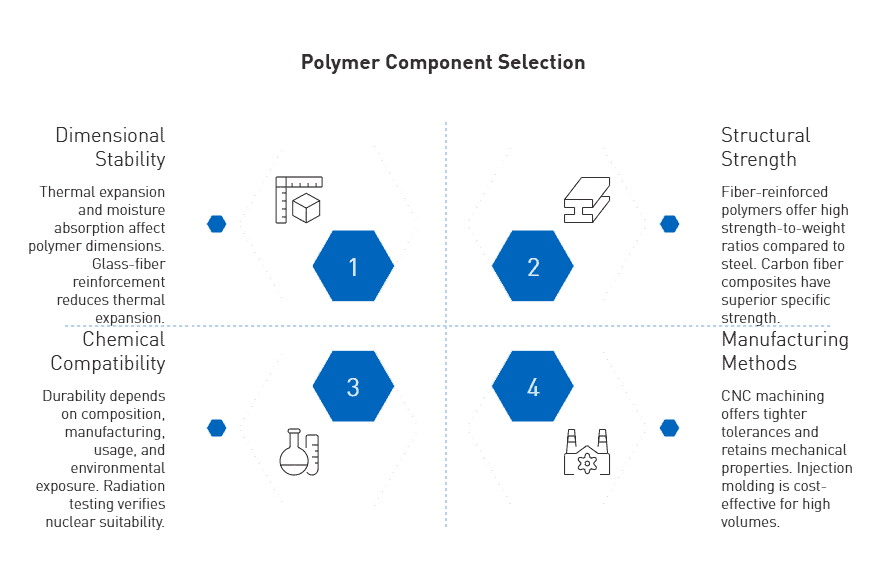
Coefficient of thermal expansion (CTE) governs how polymers change dimensions with temperature fluctuations. While metals like aluminum show CTEs around 23 × 10⁻⁶/°C, unfilled plastics range from 30-200 ppm/°C. Glass-fiber reinforced grades reduce this to 21-36 × 10⁻⁶/°C and approach metal stability. PEEK maintains high thermal stability with CTE values of 4.7-10.8 × 10⁻⁵/°C, while 30% carbon fiber reinforcement lowers this to 1.5 × 10⁻⁵/°C. Moisture absorption adds to dimensional challenges, since nylon can grow 0.5-0.6% at equilibrium.
Structural Strength and Weight Considerations
Fiber-reinforced polymers provide strength-to-weight ratios several times higher than steel while remaining 80% lighter. Carbon fiber-epoxy composites achieve specific strengths of 785 kN·m/kg compared to steel’s 46.4 kN·m/kg.
Chemical Compatibility and Long-Term Durability
Durability hinges on polymer composition, manufacturing process, usage regimes, and environmental exposure levels. Radiation testing at 10⁹ rads verifies nuclear environment suitability.
Manufacturing Methods: Machined vs. Injection Molded Parts
CNC machining reaches tolerances of 0.001″ versus injection molding’s 0.005″, with machined parts retaining full mechanical properties of high-performance polymers. Injection molding makes economic sense for volumes exceeding thousands of units.
Conclusion
We’ve explored how high-performance polymers deliver mission-critical reliability in defense applications that face extreme conditions. PEEK, TORLON PAI, and ULTEM PEI withstand temperature swings from -65°F to 400°F, aggressive chemical exposure, and intense radiation levels.
Proper material selection requires balancing thermal expansion coefficients, strength-to-weight ratios, and chemical compatibility against operational requirements. These polymer solutions continue proving their value in weapons systems, aircraft components, and naval vessels where traditional metals fall short.
For defense programs where material performance directly affects reliability, sourcing the right polymer component starts with the right engineering conversation. At AIP Precision Machining, we support teams with consultative material selection, DFM guidance, rapid prototyping, and precision machining of high-performance polymers for demanding operating environments.
If your program requires polymer components engineered for heat, chemicals, wear, moisture, dimensional stability, or metal replacement, contact AIP to discuss your application requirements with our technical team.