Key Takeaways
Advanced aerospace plastics are revolutionizing flight systems by delivering exceptional performance while meeting stringent safety and regulatory requirements across diverse applications.
- Weight reduction drives fuel efficiency: Carbon fiber reinforced polymers achieve 30-50% weight reduction compared to metals, delivering 20-25% fuel savings in modern aircraft like Boeing’s 787 Dreamliner.
- Extreme performance specifications: High-performance plastics like PEEK and polyimides withstand temperatures up to 343°C while resisting aviation fuels and maintaining dimensional stability.
- Precision manufacturing meets strict standards: CNC machining achieves ±0.0254mm tolerances while adhering to AS9100 certification and FAA compliance requirements for safety-critical applications.
- Smart materials enable adaptive systems: Piezoelectric polymers and shape memory alloys create morphing wing structures and active vibration control without traditional mass penalties.
- Nanocomposite integration enhances properties: Carbon nanotube incorporation at just 1% loading increases elastic stiffness by 36-42% and tensile strength by 25% over conventional composites.
The aerospace industry’s continued investment in advanced polymer technologies positions these materials as essential components for next-generation aircraft design, combining unprecedented performance capabilities with regulatory compliance and manufacturing precision. Aerospace plastic components have transformed aircraft design, with composite materials now representing much of modern aircraft structures. Fiber-reinforced polymer composites deliver substantial weight reductions and performance improvements compared to traditional metal components. These advanced aerospace polymers enable engineers to create lighter, more fuel-efficient aircraft while maintaining structural integrity and safety standards.
High-performance aerospace plastics serve critical functions in flight system components, from aircraft interiors to propulsion systems. We’ll get into the engineering applications of aerospace engineering plastics and cover material specifications, manufacturing processes, and quality compliance standards. Emerging polymer technologies are also part of this discussion. You’ll find how machined plastic aerospace components meet demanding performance requirements while adhering to FAA and AS9100 certification standards.
Primary Aerospace Plastic Components in Flight Systems
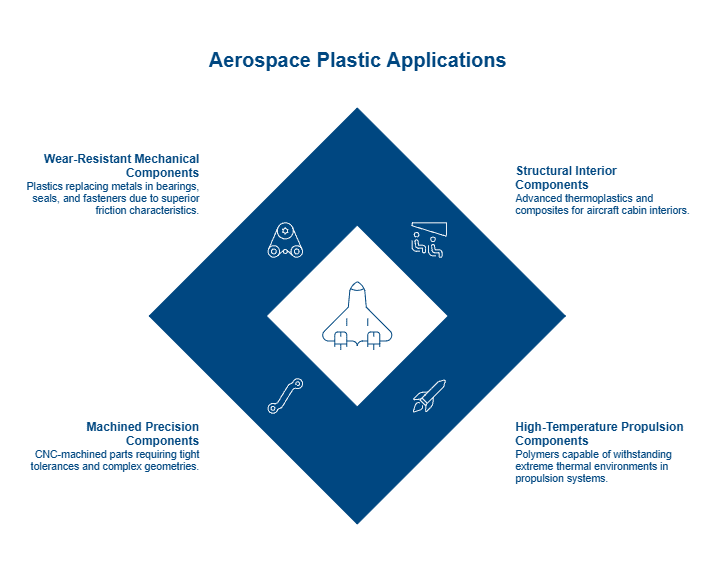
Flight systems incorporate aerospace plastic components in multiple operational domains. Each domain requires distinct material characteristics and performance specifications.
Structural Aircraft Interior Plastic Components
Aircraft cabin interiors use advanced thermoplastics for seats, composite panels, in-flight entertainment systems, windows, bins and lighting systems. These interior applications include class dividers, dashboard enclosures, galley components, lavatory assemblies, video screen bezels, gap covers, sidewall panels, tray tables, window shades, air ducts, bulkhead laminates and light housings.
Materials like Kydex and Boltaron meet FAA requirements for flame, heat release and smoke generation under FAR 25.853 standards. Radel polyphenylsulfone (PPSU) delivers high impact resistance combined with heat resistance. It meets aircraft flammability requirements of 14 CFR Part 25. Aircraft interior panels employ sandwich composites with honeycomb cores bonded to glass fiber epoxy prepreg outer layers. Thermoplastic polymers paired with structural foams create non-structural panels through vacuum forming. This offers fast and economical production using recyclable materials.
High-Temperature Aerospace Components for Propulsion
Propulsion systems require polymers that can withstand extreme thermal environments. Cryogenic rocket engines use carbon fiber reinforced plastic (CFRP) for outer shells paired with porous carbon/carbon (C/C) fiber ceramic components for inner liners. These composite materials demonstrate density between 1.3 and 1.6 g/cm³. They are approximately five times lighter than copper and nickel metals currently used. The C/C liner remains stable beyond 2000°C in reducing atmospheres. It proves damage tolerant without melting phase transitions that affect metals.
Machined Plastic Aerospace Components for Precision Systems
CNC machining produces precision aerospace components from materials including Vespel, Torlon, Ultem, PEEK, Delrin and Teflon. These machined parts serve applications that require tight tolerances and complex geometries. PEEK resists combustion up to 600°C while maintaining chemical resistance against jet fuel and hydraulic fluids. This makes it suitable for convoluted tubing and engine components. Polycarbonate provides exceptional transparency for aircraft windows, flight controls and safety equipment. Ultem demonstrates dimensional resistance against stress and cracking for ventilation systems, latches and food service equipment.
Aerospace Wear-Resistant Components for Mechanical Applications
Wear-resistant plastics replace metals in bearings, bushings, seals and fasteners due to superior friction characteristics and tight tolerances. Torlon polyamide-imide (PAI) offers self-lubricating properties for thermal isolators, sector gears and bushings in hot and cold temperature ranges. PTFE provides low coefficient of friction for fuel hoses, electrical connections and cable insulation. Nylon serves as a metal replacement in engine components, piping systems, hydraulics and landing gear applications.
Material Properties and Performance Requirements
Performance specifications for aerospace polymers establish the boundaries within which materials maintain structural and functional integrity in demanding operational environments.
High-Performance Aerospace Plastics: Thermal Stability Specifications
Polyimides show exceptional high-temperature resistance with glass transition temperatures reaching 266°C to 385°C and maintain decomposition temperatures between 482°C and 537°C. PEEK exhibits continuous use temperatures up to 260°C with a melting point of 343°C. Thermal stability assessment employs thermogravimetry and differential scanning calorimetry to review decomposition mechanisms. Polyamide-imide demonstrates greater strength at 200°C than other thermoplastics exhibit at room temperature and withstands continuous operating temperatures up to 260°C. Certain polysialates remain stable up to 1300-1400°C, while fluoropolymer variants display decomposition temperatures exceeding 500°C.
Chemical-Resistant Aerospace Plastics for Fuel and Fluid Contact
PEEK maintains exceptional properties at temperatures up to 260°C and withstands aviation fuels and hydraulic fluids without degradation. Fluorinated elastomers, including FKM formulations, demonstrate compatibility with aggressive fuels such as JP-9 and JP-10 at elevated temperatures. Epoxy matrix composites exhibit high fluid resistance to simple service fluids, though less resistance to acidic service-fluids.
Dimensionally Stable Aerospace Materials: Tolerances and Standards
ASTM D1204 measures linear dimensional change resulting from temperature exposure. The percent change is calculated as final length minus original length divided by original length and multiplied by 100. Dimensionally stable plastics exhibit low coefficient of thermal expansion, minimal moisture absorption and low internal stress. PTFE demonstrates zero water absorption, while polyimides, PEEK and PPS show very low absorption rates. Glass fiber reinforcement substantially reduces thermal expansion coefficients to values comparable with aluminum.
Low Outgassing Aerospace Materials for Space Applications
ASTM E-595 establishes acceptance criteria requiring total mass loss below 1.0% and collected volatile condensable materials below 0.10%. Testing occurs in vacuum of 10⁻⁶ Torr at 125°C for 24 hours. Ultra-low-outgassing formulations achieve TML of 0.1% or less and CVCM of 0.01% or less. Excessive outgassing degrades structural integrity, contaminates optical surfaces and compromises thermal control properties. Materials failing outgassing requirements face removal from assembled flight vehicles and necessitate replacement with approved alternatives.
Manufacturing Processes and Quality Compliance
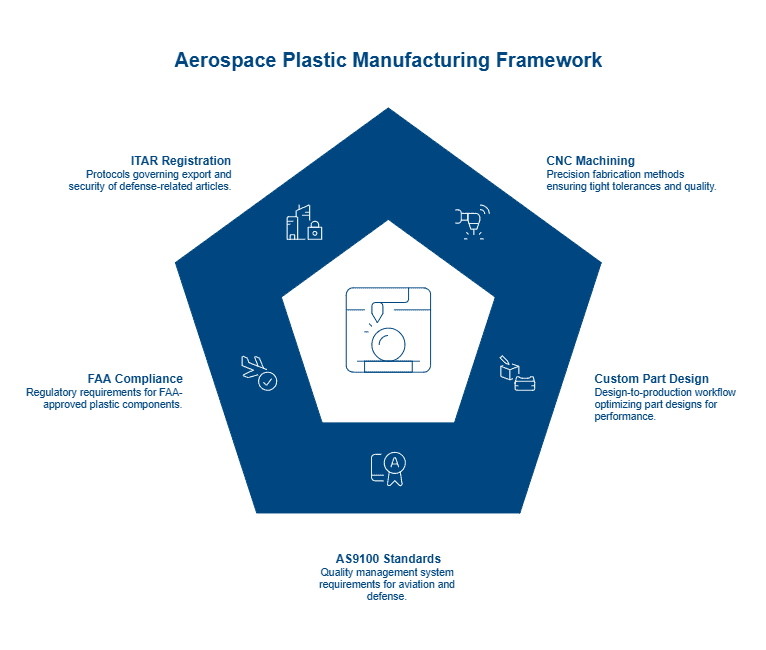
Manufacturing aerospace plastic components requires adherence to stringent fabrication standards and regulatory frameworks that govern quality, traceability, and security throughout production.
CNC Machining Aerospace Plastics: Precision Fabrication Methods
Aerospace plastic machining achieves tolerances within ±0.0254 mm using precision tooling and controlled spindle speeds. High-performance polymers exhibit low thermal conductivity and require sharp tools with optimized chip evacuation to prevent heat-induced warping. Toolpath design, workholding strategies, and fixture selection affect dimensional stability for parts requiring ±0.001″ precision.
Custom Aerospace Plastic Parts: Design-to-Production Workflow
First Article Inspection confirms that manufacturing processes produce parts meeting engineering specifications. FAI involves detailed examination and measurement verification before full production begins. Material certifications, production controls, and inspection results require documented traceability. Design for manufacturing assistance optimizes part designs for cost and performance before tooling fabrication.
AS9100 Aerospace Machining Standards and Certification
AS9100 establishes quality management system requirements for aviation, space, and defense organizations. The standard supplements ISO 9001 with aerospace-specific requirements including operational risk management, supply chain management, and traceability. Organizations certified to AS9100 appear in the Online Aerospace Supplier Information System database that the International Aerospace Quality Group manages.
FAA-Compliant Plastic Components: Regulatory Requirements
FAA-approved parts include those produced under Parts Manufacturer Approval, Technical Standard Order Authorization, or type certification procedures. Replacement parts must conform to FAA-approved data, with installers determining article eligibility prior to installation.
ITAR Registered Aerospace Manufacturer Protocols
International Traffic in Arms Regulations govern export, import, and brokering of defense-related articles that the US Department of State’s Directorate of Defense Trade Controls administers. ITAR registration requires submitting documentation to show compliance with regulations controlling items listed on the United States Munitions List. Registered manufacturers implement security measures that limit access to Controlled Technical Information and restricted production areas.
Advanced Polymer Technologies for Next-Generation Flight Systems
Emerging material technologies expand the performance envelope of aerospace plastic components through molecular-scale engineering and advanced processing methodologies.
Fiber-Reinforced Polymer Composites: CFRP and Glass Fiber Systems
Carbon fiber reinforced polymers achieve 30-50% weight reduction compared to aluminum and titanium alloys while delivering 20-25% fuel savings. Boeing’s 787 Dreamliner incorporates about 50% composite materials by weight in primary structures. These include wings, fuselage and tail assemblies. These fiber composites reduce CO2 emissions by up to 20% during operations. Glass fiber systems provide balanced strength, fiber toughness and impact resistance for aircraft interiors. Baggage bins, flooring and radomes also benefit from these systems. S-2 glass fibers deliver improved performance for rotor blades and fan components where high-temperature stability exceeds 300°C.
Nanocomposite Integration: Improved Properties Through Nanoscale Fillers
Carbon nanotube incorporation at 1 wt% loading increases elastic stiffness by 36-42% and tensile strength by 25%. Single-walled nanotubes demonstrate Young’s modulus values reaching 1.25 TPa. Nanoscale fillers improve modulus, gas barrier properties and atomic oxygen resistance. Thermal performance also goes beyond conventional carbon fiber composites. Aramid fiber composites modified with nanoparticles show tensile strength increases of 51.03%.
Smart Polymer Systems: Piezoelectric and Shape Memory Materials
Piezoelectric materials allow active vibration control in aero-engine blades without mass penalties that passive dampers bring. NASA testing confirmed piezoelectric ceramics including PZT-4 and PZT-5A for sensor and actuator applications. Temperature ranges from -150°C to 250°C were tested. Shape memory alloys integrated into composite wings allow morphing structures that adapt airfoil geometry in different flow regimes.
Thermoplastic vs Thermosetting Resins: Application-Specific Selection
Thermoplastic composites allow 20-30% aircraft weight reduction compared to aluminum structures. Processing advantages include cycle times about 10 times faster than thermoset equivalents. Autoclave co-consolidation requires three hours versus seven to nine hours for cured epoxies. Thermoplastics offer recyclability through remelting capabilities, while thermosets provide superior dimensional stability and heat resistance up to 500°F.
Conclusion
Aerospace plastic components continue to expand their role in modern flight systems because they address some of the industry’s most critical engineering demands: weight reduction, thermal stability, chemical resistance, dimensional precision, and long-term performance. From aircraft interiors and wear components to propulsion-adjacent systems and precision-machined assemblies, advanced polymer materials give engineers more flexibility to optimize performance without the penalties associated with heavier traditional materials. As aerospace requirements become more demanding, the strategic use of high-performance plastics and composites will remain essential to improving efficiency, reliability, and manufacturability across next-generation aircraft platforms.
Need a machining partner for aerospace plastic components? AIP Precision Machining helps engineers and OEM teams develop high-performance polymer parts for demanding aerospace applications, with a focus on precision, material expertise, and application-specific support. Contact our team to discuss your design, material requirements, and production goals.