Aerospace polymers significantly reduce aircraft weight by 50% compared to metal parts, revolutionizing how manufacturers approach structural component design. This weight reduction directly translates to improved fuel efficiency and substantially lower operational costs across the aviation industry. Furthermore, the global aerospace plastics market reached $7.61 billion in 2023 and is projected to grow to $13.89 billion by 2030, highlighting the increasing importance of these materials.

High-performance thermoplastics like PEEK, ULTEM®, and Vespel® offer unique advantages that make them ideal for aerospace applications. PEEK maintains its structural integrity at temperatures as high as 480 degrees Fahrenheit and demonstrates outstanding resistance to chemicals, aircraft fuels, and steam without degradation. Meanwhile, ULTEM® (polyetherimide) boasts an excellent strength-to-weight ratio, while plastic aerospace components can reduce manufacturing time by 80% — from hours to minutes.

This technical comparison examines the thermal, mechanical, and flame-resistant properties of these three high-performance aerospace grade polymers, specifically focusing on their applications in cabin interiors, flight control systems, and precision components.


Thermal and Flame Resistance Comparison of ULTEM®, PEEK, and Vespel®

The thermal properties of aerospace polymers directly affect their performance in extreme conditions. Each material exhibits distinctive characteristics that determine its suitability for specific aerospace applications.

Glass Transition Temperature (Tg) and Melting Point (Tm) Benchmarks

The fundamental difference between these polymers lies in their molecular structure. ULTEM® is amorphous with a high glass transition temperature (Tg) of approximately 217°C (420°F). In contrast, PEEK is semi-crystalline with a lower Tg of around 143-150°C (289°F) but features a crystalline melting point of 343°C (649°F). This morphological difference explains why PEEK maintains structural integrity at temperatures exceeding its Tg. Vespel® polyimide completes the trio with exceptional thermal stability, allowing it to maintain performance across extreme temperature ranges.


Continuous Use Temperature: 500°F for PEEK vs 340°F for ULTEM®

Despite ULTEM®’s higher Tg, its continuous service temperature reaches only 340°F (171°C), primarily because amorphous regions soften above Tg. PEEK, however, can withstand continuous operating temperatures up to 500°F (260°C) because its crystalline regions remain stable above Tg. Vespel® surpasses both with continuous performance at temperatures up to 572°F (300°C), making it ideal for the most thermally demanding aerospace applications.


Flame Smoke Toxicity (FST) Ratings and FAA Compliance

Both ULTEM® and PEEK hold UL 94 V-0 flammability ratings. Additionally, ULTEM® achieves the more stringent 5VA rating at 1.6mm thickness and exhibits a higher Limiting Oxygen Index (LOI) of 47%. These properties ensure ULTEM® meets FAA 25.853 standards, particularly valuable for cabin interiors. For aerospace applications, materials must pass comprehensive Fire, Smoke, and Toxicity (FST) testing, including smoke density tests requiring values below 200 after burning for four minutes. Toxicity testing measures concentrations of critical gasses including carbon monoxide, hydrogen cyanide, and hydrogen chloride.


Thermal Cycling Stability in Aerospace Environments

Aerospace environments subject materials to repeated thermal cycling—from extreme cold at high altitudes to high heat during operation. Under such conditions, PEEK handles temperature variations from -55°C to +95°C without degradation. Notably, thermal cycling actually improves certain polymer properties; research shows that after multiple cycles, the glass transition temperature increases by 5-10°C and storage modulus rises significantly. ULTEM® 1000 maintains its toughness and impact resistance during temperature fluctuations, offering good dimensional stability in spacecraft applications.


Mechanical and Fatigue Performance Under Aerospace Loads

Structural integrity under mechanical stress represents a critical performance factor for aerospace polymers, especially when components face extreme operational conditions. Selecting the appropriate material requires thorough analysis of tensile strength, creep behavior, and fatigue resistance.


Tensile Strength: 16,000 psi (ULTEM®) vs 23,000 psi (Vespel®)

Tensile strength varies significantly among high-performance aerospace polymers. ULTEM® demonstrates a tensile strength of 15,200 psi (105 MPa) in its unfilled grade, which increases with glass-fiber reinforcement—reaching 17,000 psi in the 30% glass-filled ULTEM® 2300 variant. Vespel® polyimide excels with tensile strength reaching approximately 23,000 psi, making it suitable for highly stressed components. Torlon PAI positions between these two with 21,000 psi, establishing it as the strongest unreinforced thermoplastic available for industrial applications.


Impact Resistance and Creep Behavior in High-Stress Parts

Creep resistance—a material’s ability to resist deformation under constant stress—proves essential for aerospace components. Vespel® exhibits exceptional creep and stress relaxation behavior that outperforms virtually all other polymers, maintaining sealing force in high-pressure applications over extended periods. Essentially, polymers with higher crystallinity demonstrate lower creep rates. This characteristic makes semi-crystalline polymers like PEEK generally more creep-resistant than amorphous alternatives such as ULTEM®. Creep damage typically reaches maximum values (approximately 15% void fraction) in the tertiary stage of the creep process, with damage accelerating exponentially with increasing stress levels.


Fatigue Resistance in Repeated Load Cycles

Aerospace components routinely encounter cyclic loading that can lead to fatigue failure—often at stress levels well below ultimate tensile strength. High-cycle fatigue (HCF) testing simulates real-world operational conditions for components experiencing low stress and high-frequency cycles (typically above 10⁶ cycles). Conversely, low-cycle fatigue (LCF) evaluates performance under high stress and low-cycle loading (below 10⁵ cycles). Subsequently, PEEK demonstrates superior fatigue resistance compared to ULTEM®, particularly in dynamic environments subject to repeated stress.


Dimensional Stability in Precision Aerospace Parts

Precision aerospace applications demand exceptional dimensional stability across fluctuating environmental conditions. Torlon demonstrates excellent dimensional stability even at elevated temperatures, with a glass transition temperature of 280°C (536°F), allowing for consistent performance in precision applications. Consequently, high-performance polymers maintain tight tolerances in aircraft systems where precision directly impacts safety and performance.


Application Mapping: Where Each Polymer Excels in Aircraft Systems

Each aerospace polymer excels in specific aircraft applications based on its unique property profile.


PEEK in Flight Control and Engine Components

PEEK’s superior thermal resistance enables continuous operation at temperatures up to 500°F (260°C), making it ideal for engine casings, seals, and thrust washers. Flight control components, fuel system elements, and aerodynamic-related components frequently utilize PEEK primarily due to its exceptional strength-to-weight ratio. Accordingly, aircraft manufacturers achieve substantial weight savings—up to 60% when converting metallic components to PEEK.


ULTEM® in Cabin Interiors and Ventilation Systems

ULTEM® meets stringent FAA regulations for passenger safety. Throughout modern aircraft, this material appears in ventilation systems, personal service units, food service equipment, and oxygen delivery systems. Moreover, advanced cabin design specifications mandate ULTEM® integration throughout passenger interface systems. The Airbus A350 platform incorporates over 1,000 ULTEM®-based components, demonstrating successful aerospace qualification.


Vespel® in Vacuum Seals and High-Wear Bearings

For high-pressure spline connections transmitting power to aircraft systems, Vespel® polyimide couplings installed between mating metal splines ensure smoother operation. The polymer’s ductility allows shaft misalignment without creating excessive stress on metal components. Unlike standard thermoplastics, Vespel® exhibits no observable glass transition temperature or abrupt softening point. This enables continuous operation at 500°F with excursions to 900°F.


Precision Parts for Aircraft Interiors: Latches, Panels, and Connectors

High-performance polymers enable reliable performance in critical load-bearing applications, including precision-engineered latches, hinges, and access mechanisms. RADEL® PPSU meets aircraft flammability requirements per 14 CFR Part 25, providing engineers with material options that are lightweight, safe, and esthetically pleasing. This material offers exceptional toughness while meeting OSU 65/65 and FAR 25.853 standards.


Custom Precision Aerospace Parts for Fuel and Electrical Systems

PEEK’s chemical unreactivity allows it to withstand constant exposure to aviation fuels and hydraulic fluids without degradation. It’s extensively used in convoluted tubing protecting critical electrical systems. ULTEM®’s superior dielectric properties establish technical leadership in aircraft electrical systems, enabling reliable performance in power distribution infrastructure and electronic control systems.

Need material guidance? Our experts will help you match the right polymer to your spec. https://aipprecision.com/get-a-quote/


Machinability, Certifications, and AIP’s Aerospace Capabilities

Precision manufacturing of aerospace polymers requires specialized equipment and technical expertise beyond standard plastic machining capabilities. The process demands strict adherence to industry regulations while maintaining exceptional dimensional accuracy.


5-Axis CNC Machining for Aerospace Grade Plastics

Advanced 5-axis CNC technology enables manufacturers to create complex aerospace components with intricate geometries. This precision technology allows single-setup machining, thereby eliminating alignment errors between operations. Five-axis capabilities prove indispensable when producing components with compound angles, undercuts, or features requiring simultaneous multi-axis control.


AS9100D and ITAR Certification for Aerospace Compliance

Quality management systems certified to AS9100D standards ensure consistent production processes throughout the aerospace supply chain. Furthermore, International Traffic in Arms Regulations (ITAR) registration confirms a manufacturer’s compliance with export control requirements for defense-related parts. These certifications establish trust throughout the industry by verifying adherence to standardized quality protocols.


Post-Curing Requirements for Vespel® and Torlon®

After initial machining, Vespel® and Torlon® parts require thermal post-curing to achieve their final mechanical properties. This critical heat-treatment process stabilizes dimensions, releases internal stresses, and develops optimal material characteristics. The process often extends over several days through carefully controlled temperature staging.


Tolerances and Surface Finish in Precision Plastic Machining

High-performance thermoplastics can maintain tolerances as tight as ±0.001″ with proper machining protocols. Surface finish specifications typically range from 16-64 RMS depending on application requirements. Machining strategies must account for material-specific thermal expansion characteristics.


AIP’s Experience with High-Performance Thermoplastics

AIP Precision Machining specializes in producing complex aerospace polymer components through validated manufacturing processes. Their expertise includes material selection consulting, design optimization, and quality assurance throughout production.


Conclusion

High-performance aerospace polymers—PEEK, ULTEM®, and Vespel®—have proven themselves across critical performance metrics including thermal stability, mechanical strength, and regulatory compliance.

PEEK offers the best balance of continuous thermal resistance (up to 500°F) and fatigue performance, making it ideal for engine components, flight control systems, and fuel-handling parts. ULTEM® delivers superior flame-smoke-toxicity compliance, meeting FAA 25.853 standards for cabin interiors and electrical systems. Vespel® stands out for exceptional creep resistance and dimensional stability in extreme thermal and pressure environments, such as high-wear seals and precision bearings.

Ultimately, the right material depends on application-specific demands—whether it’s sustained thermal load, exposure to aggressive fluids, or the need for ultra-tight tolerances in dynamic systems.

Combined with advanced 5-axis CNC machining, post-curing expertise, and AS9100D-certified processes, these polymers enable significant weight reduction, increased design flexibility, and extended component lifespan across commercial and defense aerospace platforms.

AIP Precision Machining supports engineers and sourcing leaders with material selection, design optimization, and precision manufacturing strategies tailored to your exact aerospace requirements.


FAQs

Q1. What are the key differences between ULTEM®, PEEK, and Vespel® in aerospace applications?

ULTEM® excels in flame resistance and is ideal for cabin interiors, PEEK offers superior thermal and chemical resistance for engine components, while Vespel® provides exceptional dimensional stability and creep resistance for high-pressure seals and bearings.


Q2. How do these aerospace polymers compare in terms of continuous use temperature?

PEEK can withstand continuous operating temperatures up to 500°F (260°C), ULTEM® reaches 340°F (171°C), and Vespel® surpasses both with performance at temperatures up to 572°F (300°C).


Q3. What are the weight reduction benefits of using these polymers in aircraft?

High-performance aerospace polymers can reduce component weight by up to 50% compared to traditional metal parts, significantly improving fuel efficiency and lowering operational costs.


Q4. How do these materials perform in terms of flame resistance for aerospace applications?

Both ULTEM® and PEEK hold UL 94 V-0 flammability ratings, with ULTEM® achieving the more stringent 5VA rating and meeting FAA 25.853 standards, making it particularly valuable for cabin interiors.


Q5. What manufacturing processes are used for creating aerospace components from these polymers?

Advanced 5-axis CNC machining technology is used to create complex aerospace components with intricate geometries. Some materials like Vespel® and Torlon® require thermal post-curing to achieve their final mechanical properties.

Follow AIP Precision Machining on Linkedin

linkedin logo

Biocompatible plastics have revolutionized the medical implant industry, offering distinctive advantages over traditional materials for long-term implantation. These specialized synthetic polymers provide superior performance when used within the human body, ensuring devices don’t trigger adverse reactions. Specifically, PEEK (polyether ether ketone) stands as one of the most common polymer choices for implantable medical devices, available in FDA and USP Class VI approved medical grades.

Since receiving FDA approval in 1998, PEEK has been recognized as a viable polymer for bone substitution. What makes this high-performance thermoplastic particularly valuable is its mechanical properties, which closely resemble those of human bone, providing necessary support and stability in structural implants. Furthermore, PEEK exhibits excellent biocompatibility for long-term implantation while demonstrating remarkable chemical resistance. Although it can be an expensive option, the combination of properties and reliability makes PEEK well worth the investment for medical applications. This guide examines the selection criteria for implant-grade biocompatible plastics, from initial material testing through FDA approval processes, helping engineers and regulatory professionals navigate the complex landscape of medical-grade polymers.


Understanding the Role of Biocompatible Plastics in Implants

Medical device engineers increasingly select polymers over traditional metallic materials for implantable applications. This shift stems from several critical advantages that biocompatible plastics offer in addressing the complex challenges of long-term implantation.

Why Polymers Are Replacing Metals in Medical Devices

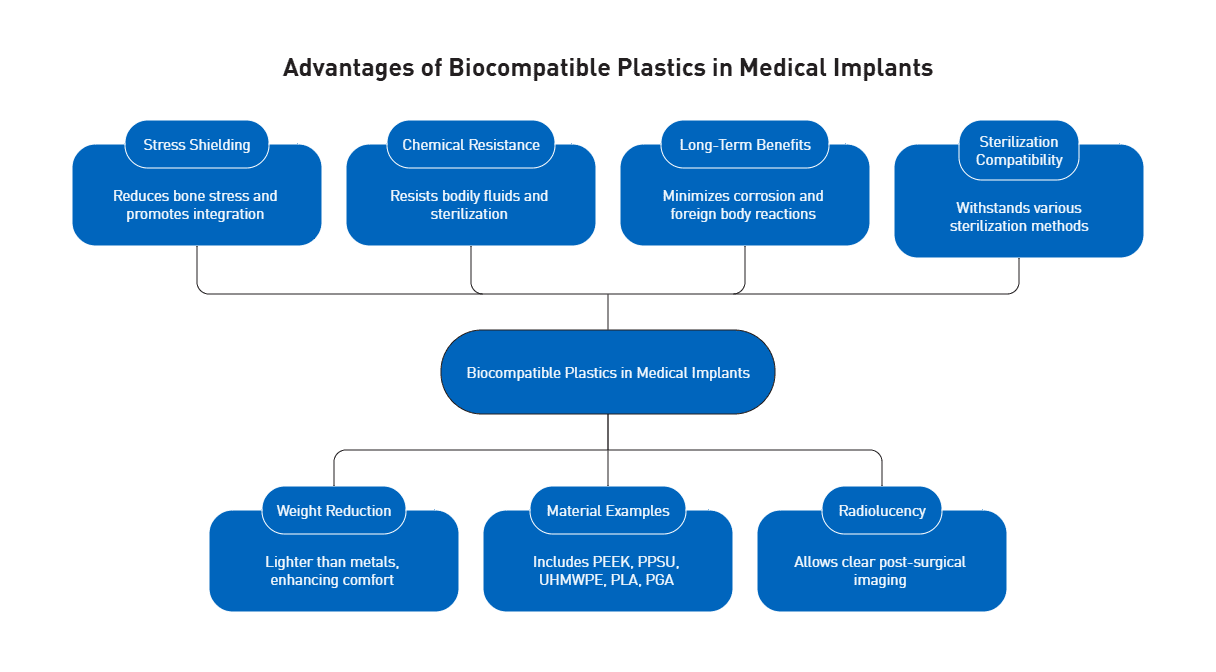
The phenomenon of “stress shielding” represents a significant issue with metallic implants. When stainless steel components are implanted, the bone experiences reduced mechanical stimulation due to the implant’s rigidity, eventually leading to loosening over time. In contrast, polymers like PEEK demonstrate flexibility closely matching natural bone structure. This mechanical compatibility reduces interface stress between the implant and surrounding tissue, promoting better long-term integration. Additionally, biocompatible plastics weigh substantially less than metals—up to ten times lighter—while offering superior chemical and corrosion resistance against bodily fluids and sterilization processes.


Examples of Implantable Device Materials in Use Today

The medical implant landscape features several prominent biocompatible polymers. The four traditional mainstay polymers—polyvinyl chloride (PVC), polypropylene (PP), polyethylene (PE), and polystyrene (PS)—continue to serve various applications. However, more specialized materials have emerged for implantable use. PEEK dominates in spinal fusion cages, having largely replaced titanium due to its bone-like mechanical properties. PPSU (polyphenylsulfone) offers exceptional strength, dimensional stability, and compatibility with bodily fluids. Ultra-high molecular weight polyethylene (UHMWPE) serves as a critical component in nearly all total knee replacements and many hip replacements, providing necessary cushioning and movement. Moreover, bioresorbable options like polylactic acid (PLA) and polyglycolic acid (PGA) offer temporary structural support that gradually dissolves as the body heals.


Benefits of Biocompatible Plastics for Long-Term Use

Biocompatible plastics deliver numerous advantages for extended implantation periods. Their inherent resistance to corrosion eliminates degradation concerns that plague metal implants. Furthermore, these materials minimize foreign body reactions—a critical factor in implant longevity. The radiolucency of polymers like PEEK facilitates post-surgical imaging without interference, allowing for more accurate monitoring of healing and potential complications. Notably, the flexibility to modify surface properties through various treatments enhances osseointegration capabilities. Biocompatible polymers also withstand multiple sterilization methods including steam, ethylene oxide, and gamma radiation without compromising structural integrity.


Mechanical and Biological Properties of Common Polymers

The mechanical and biological characteristics of polymers determine their suitability for specific implant applications and their long-term performance within the human body.

Elastic Modulus and Bone-Matching Behavior

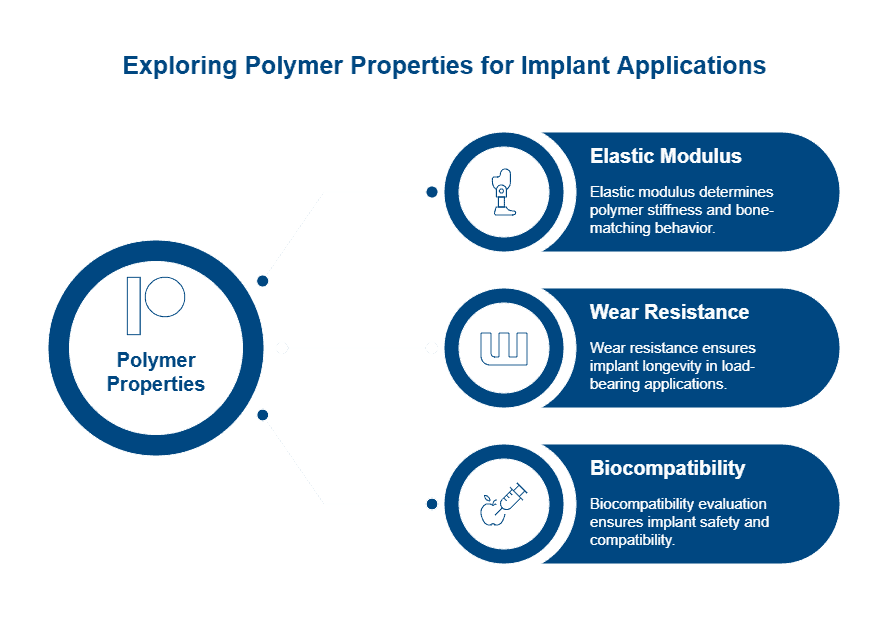
The elastic modulus (Young’s modulus) of polymers represents their stiffness or resistance to deformation. This property is crucial for implant selection as bone’s natural modulus ranges from 4 to 30 GPa. Biomaterial engineers seek polymers with comparable values to prevent stress shielding—a phenomenon where overly rigid implants cause bone resorption. Unlike metals with moduli approximately 10 times higher than bone, titanium and its alloys demonstrate values roughly half that of stainless steel, reducing stress shielding risk.

Various factors influence polymer elasticity, including molecular structure, chain flexibility, cross-linking degree, and environmental conditions. Testing methods include ultrasonic pulse velocity measurement, flexural resistance evaluation, and microhardness indentation—with the latter proving effective for estimating elastic moduli of filled polymers.


Wear Resistance and Fatigue Life in Load-Bearing Applications

Implant longevity primarily depends on wear resistance and fatigue life, especially in joint replacements. Primary failure modes include wear, yielding, creep, fatigue, fracture, and delamination. Wear-induced biological failure commonly occurs around hip replacements when debris accumulates, triggering inflammation, bone loss, and aseptic loosening.

Highly crosslinked ultrahigh molecular weight polyethylene (HXLPE) demonstrates superior wear resistance compared to non-crosslinked UHMWPE, consequently reducing particulate debris risk—albeit with diminished toughness and fatigue resistance. Fatigue testing shows biodegraded specimens exhibit 81-95% lower fatigue lifetime compared to non-degraded samples at stress levels between 2.5-10 MPa.


Biocompatibility and Cytotoxicity Profiles

Biocompatibility evaluation follows ISO 10993 standards within a risk management framework. This process begins with assessing material components, manufacturing processes, anatomical location, and exposure duration. The cytotoxicity test, described in ISO 10993-5, serves as the most sensitive initial biocompatibility screening.

Testing typically involves extracting devices in cell culture media and exposing mouse fibroblast (L929) cells to evaluate toxicity. Evaluation methods include qualitative microscopic assessment (grading 0-4) or quantitative measurement using tetrazolium dye to assess cell metabolic activity. Importantly, a failed cytotoxicity test doesn’t necessarily indicate clinical safety risk but requires systematic investigation.


Manufacturing and Post-Processing Considerations

The precision manufacturing of biocompatible plastics presents unique challenges that directly impact implant performance. Properly executed production processes ensure device efficacy while inappropriate methods can compromise biocompatibility and mechanical integrity.


Plastic Machining for Medical Devices: Tolerances and Challenges

Manufacturing biocompatible implants requires exceptional precision. CNC machining can achieve tolerances as tight as ±0.001″ for critical medical components, nevertheless material-specific factors affect achievable precision. Acetal and PEEK components maintain tolerances of +/-.001″, whereas nylon requires more generous allowances at +/-.002″. Furthermore, thermal management presents a significant challenge as polymers have higher coefficients of thermal expansion than metals. Preventing stress-induced warping requires specialized techniques—initially performing rough machining followed by a relaxation period allows internal stresses to dissipate before finishing operations.


Injection Molding vs. Additive Manufacturing for PEEK

Injection molding remains the gold standard for high-volume production of biocompatible implants, offering exceptional dimensional accuracy within tolerances as tight as +/- 0.005 inches. In contrast, additive manufacturing (AM) provides design freedom for complex geometries without sophisticated tooling. Despite these advantages, 3D-printed parts typically demonstrate inferior mechanical properties—approximately 80% lower Young’s modulus and 70% reduced tensile strength compared to injection-molded equivalents. Interestingly, research shows adding 1 wt% IF-WS2 nanoparticles to 3D printed PEEK can overcome reduced stiffness, resulting in properties surpassing unfilled injection-molded PEEK.

Surface Modification for Improved Osseointegration

Surface modification significantly enhances implant integration with bone tissue. Techniques including sand-blasting, large-grit, and acid-etching (SLA) improve mechanical interlocking with adjacent bone. For optimal results, biomimetic approaches create surfaces that mimic natural bone’s micro-nano-scale hierarchical structures. Additionally, coating implants with hydroxyapatite or other calcium phosphates promotes faster osseointegration through improved bioactivity. Surface treatments that incorporate zinc ions demonstrate enhanced antimicrobial properties while stimulating osteoblasts through interaction with Runx2 transcription factors.


Sterilization Effects on Polymer Integrity

Sterilization methods significantly impact polymer performance. High-energy methods (gamma and E-beam irradiation) induce polymer chain scission and crosslinking, altering molecular weight, crystallinity, and mechanical properties. These effects are more pronounced in degradable polymers with polar ester linkages. Steam sterilization (121°C/15min or 134°C/3min) affects surface roughness parameters—reducing maximum height (Sz value) from 41.30μm to 27.49μm in PEEK samples. Consequently, manufacturers must evaluate post-sterilization properties to ensure clinical functionality.

Ready to prototype your next implantable component? Request a quote from AIP’s medical machining team.


Compliance and Approval for Medical-Grade Polymers

Regulatory approval frameworks ensure biocompatible polymers meet stringent safety standards before clinical use. These systems protect patients through comprehensive material evaluation protocols.


ISO 10993 Plastics Testing: Cytotoxicity to Implantation

ISO 10993 serves as the primary standard for biological evaluation of medical devices within a risk management process. The standard requires assessment of physical and chemical characteristics plus exposure parameters including nature, degree, frequency, and duration of bodily contact. Testing typically begins with cytotoxicity (ISO 10993-5), the most sensitive initial biocompatibility screening. For polymers, ISO 10993-13 provides specific guidance on identifying degradation products through accelerated and real-time testing methods.


FDA-Approved Polymers and Device Class Mapping

The FDA categorizes implantable devices primarily as Class II or Class III based on risk factors. Classification considerations include treatment conditions, implantation location, device characteristics, and implantation duration. Class II devices can proceed through 510(k) clearance if risks are identifiable and manageable, whereas Class III devices typically require clinical data through the more rigorous Premarket Approval (PMA) pathway.


Implant Grade Biocompatible Plastics: Certification Process

Implant-grade materials undergo stringent certification requirements to verify biocompatibility, stability, and durability. Documentation must demonstrate non-toxicity, non-carcinogenicity, and non-irritation to biological tissues. USP Class VI represents one certification option, requiring systemic injection, intracutaneous, and implantation tests. Nevertheless, many regulatory authorities consider ISO 10993 more comprehensive, as USP Class VI lacks risk assessment components.


Navigating Custom Device Exemptions and PMA Pathways

The PMA review involves four steps: administrative review, scientific evaluation, advisory committee assessment, and final decision. Alternatively, custom device exemptions exist for unique patient needs, provided devices meet specific criteria including production limits of five units yearly per device type. Such devices must treat sufficiently rare conditions where clinical trials would be impractical.


Conclusion

The selection of biocompatible plastics for implantable medical devices demands careful evaluation of mechanical performance, biological compatibility, and regulatory compliance. Advanced polymers like PEEK, PPSU, and UHMWPE offer advantages over metals through bone-matching elasticity, resistance to stress shielding, and superior chemical durability.

Precision manufacturing—whether through CNC machining or injection molding—directly impacts implant integrity. Surface treatments and sterilization methods must be tailored to each material to maintain structural and biological performance. At the regulatory level, ISO 10993 testing and proper FDA device classification are essential for approval.

For medical engineers and OEMs, choosing the right polymer translates to safer, more effective devices. As polymer technology advances, the focus will remain on enhancing osseointegration, longevity, and patient outcomes.

Ready to prototype your next implantable component? Request a quote from AIP’s medical machining team.


FAQs

Q1. What are the main advantages of using biocompatible plastics in medical implants?

Biocompatible plastics offer several advantages over traditional metals, including reduced stress shielding, lighter weight, superior chemical resistance, and better compatibility with the human body. They also allow for improved imaging and can be modified for enhanced osseointegration.


Q2. How does PEEK compare to other materials for implantable medical devices?

PEEK (polyether ether ketone) is a popular choice for implantable devices due to its mechanical properties that closely resemble human bone. It offers excellent biocompatibility, chemical resistance, and has FDA approval for long-term implantation. While more expensive than some alternatives, its combination of properties makes it valuable for many medical applications.


Q3. What are the key considerations in manufacturing biocompatible plastic implants?

Manufacturing considerations include achieving tight tolerances through CNC machining or injection molding, managing thermal expansion during production, and applying appropriate surface modifications for improved osseointegration. Additionally, the effects of sterilization methods on polymer integrity must be carefully evaluated.


Q4. How are biocompatible plastics tested for safety and regulatory approval?

Biocompatible plastics undergo rigorous testing according to ISO 10993 standards, which include cytotoxicity, sensitization, and implantation tests. The FDA classifies implantable devices based on risk factors, with most falling under Class II or III. Approval processes may involve 510(k) clearance or the more comprehensive Premarket Approval (PMA) pathway.


Q5. What future developments can we expect in biocompatible plastics for medical implants?

Future advancements in biocompatible plastics are likely to focus on improving osseointegration capabilities, enhancing wear resistance, and developing innovative surface treatments. Research may also aim to further refine the mechanical properties of polymers to better match those of human tissues and improve long-term implant performance.

Follow AIP Precision Machining on Linkedin

linkedin logo