Precision PPSU Takes Flight in Mission-Critical Aerospace Applications

Safety and engineering finesse come together in every aircraft on the market. It’s not just about ensuring a good flight experience for consumers; it’s the law. The Federal Aviation Administration (FAA) has regulations in place that dictate the material choices for commercial aircraft. For instance, fireproof materials are an essential part of aircraft interiors.


In the late 1980s, FAA statistics showed that about 40% of survivors from impact-related aircraft crashes died from post-crash fire and smoke exposure. At the time, most aircraft interiors were made of combustible plastics. In 1987 the FAA mandated the use of fire-resistant plastics in all passenger planes.


Performance plastics like Solvay’s RADEL®, polyphenylsulfone (PPSU), offer not only high impact resistance but also high heat resistance. RADEL® is a key material in mission-critical performance within the cabin of an aircraft. In this article, we discuss the advantages of RADEL® for aerospace applications.


Demands of Aircraft Interiors – Beyond Comfort

Passengers might think about leg space and seat comfort, but there is a lot of thought put into the safety of cabin space. Fireproofing an aircraft is a crucial part of construction and engineering. Yet, engineers also look for a material that meets the industry’s lightweight and durability requisites.


Performance plastics in aerospace design have played a major role for several decades. Prior to the 1987 FAA mandate for fire-resistant plastics, most cabin interior composites were epoxy-based. These highly-flammable plastics, while providing the aesthetics and durability needed for aircraft interiors, were also highly dangerous in the event of a fire.


Since then, aircraft interior material selection has evolved to meet the standards of aesthetics, durability, AND flame resistance. Flame-resistant polymers for aircraft interiors have physical and chemical properties in terms of their effect on the heat release rate of burning material. Those qualities include: fuel replacement, flame inhibition, intumescence, and heat resistance.


These fire resistance mechanisms, acting simultaneously or collaboratively, are effective at reducing the heat release rate of a new generation of transparent plastics suitable for aircraft cabin interiors.


Properties of RADEL® PPSU for Aerospace

Solvay’s RADEL® PPSU meets all of the stringent requirements of the aerospace sector as well as the FAA regulations on flame retardance. With high heat and high impact performance, RADEL® delivers better impact resistance and chemical resistance than other sulfone-based polymers, such as PSU and PEI. It also performs under repeated chemical and hydrolytic exposure.


Furthermore, RADEL® PPSU meets the aircraft flammability requirements of 14 CFR Part 25, enabling engineers a material choice that is lightweight, safe and, aesthetically pleasing. It comes in a variety of colors to avoid painting and is FDA and NSF-approved for food and beverage contact.


Performance Properties

  • Excellent toughness and impact strength
  • Meets OSU 65/65 and FAR 25.853 (a & d)
  • Color grades eliminate painting
  • Lower-cost paintable grades
  • Flame retardant – Inherently UL-94 V0
  • Exceptional long-term hydrolytic stability


Setting the Standard for Aerospace Precision Plastic Machining

Standards in the Aerospace and Defense sector are rigorous and non-negotiable. Aviation contractors put the greatest pressure on finding manufacturers who exceed the standards of the industry.


At AIP, we make it our priority to set the standard for aerospace precision plastic machining. For over three decades, we have worked with top aviation and defense contractors to deliver cutting-edge plastic components.


We operate an ITAR facility capable of satisfying all customer DOD, NASA, and FAA quality requirements that flow down from our OEM customers. For your next precision machined PPSU project, call on AIP to exceed the standards for mission-critical aerospace applications.

 

Follow AIP Precision Machining on Linkedin

linkedin logo


What Is Orbital Reconstruction?

Orbital trauma (trauma to the facial bone structure) can happen due to injuries, benign and malignant tumors, or infectious diseases. In the case of tumors where bone extraction may be necessary, replacing the bone in the orbital region does not usually cause deformity. However, in cases where significant bony material is lost or extracted, surgeons have typically used bone grafting to restore facial form and normality.


Yet, bone grafting presents its own issues with misalignment. Medical research has turned to materials such as titanium and precision plastics like PEEK. In this insightful brief, we discuss the advantages of PEEK for maxillofacial surgical procedures.


Challenges of Maxillofacial Surgery


There are issues with bone grafting though, namely imperfect alignment and resorption. The slight variability in the three-dimensional (3D) contour of the orbit with flat or slightly curved bone grafts can have a significant aesthetic effect on the outcome.


For a patient who has suffered trauma, coming out of surgery without the aesthetics of their face is emotionally devastating. For surgeons committed to providing the highest level of medical treatment, bone grafting is not always the best option.


In these cases of orbital reconstruction, it’s common for surgeons to use alloplasty, or inert pieces of metal and plastic for reconstruction. Traditional materials for alloplastic have been titanium plates or mesh. However, challenges associated with these materials include proper fixation and revision surgery complications due to soft tissue ingrowth.


Why PEEK Is Changing the Face of This Industry


With advancements in 3D printing and subtractive manufacturing techniques in precision polymers, patient-specific implants (PSIs) have been successfully reported in facial reconstruction. More recently, polyetheretherketone (PEEK) is a polymer with ideal alloplastic properties: nonconductive, biocompatible, and stable in the setting of long-term exposure to bodily fluids, elasticity is similar to native cortical bone, and light material makes it suitable for even large defects. As medical technologies continue to advance, PEEK has become a popular pick for PSIs.


A Case Study in PEEK Implants

One of the setbacks of titanium and metallic implants is that the manufacturing process takes time. In the case of PEEK implants, subtractive manufacturing offers convenient and quick milling precision at 0.4 mm thickness. The design freedom with PEEK is also much easier to produce than with metallic implants.


In addition, PEEK offers excellent imaging properties without artifact blockage, and it is most comparable to cortical bone. Recent research has shown that PEEK is an optimal choice for patients and surgeons with regard to revision surgery as well.


In a PEEK PSI group, diplopia after surgery was absent in 82.1% of patients versus 70.6% of controls with pre-bent titanium. These results showed that PEEK PSI demonstrated higher clinical efficacy in comparison to pre-bent plates in orbital wall reconstruction, especially in restoring the volume and shape of the damaged orbit.


Comparison to Metallic Surgical Materials

The most commonly used surgical material for orbital reconstruction is titanium. Its strength and flexibility set it apart as a material that lends itself well to meld to complex facial structures. However, Polyetheretherketone (PEEK) presents a major benefit as a material pick for its thermostability and comparability to cortical bone. We’ve mapped out a comparison of these common surgical materials below.


Additive Manufacturing Titanium

3-D manufactured titanium produces surfaces without tools or devices. It also enables options for surface design and intricacies that were previously impossible. In addition, additive manufactured titanium implants are so precise they don’t require reshaping processes.

Advantages
• Wide selection of shapes, structures, and styles
• Precise fitting accuracy
• Exceptionally stability
• Osteoconductive structures are possible
• Complete design freedom for the material and its surface
• Quick operation
• Steam sterilization

Limitations
• Additional material work is required for revision surgeries
• Intraoperative cutting to length is exceptionally difficult


Titanium Mesh

The special microstructure of titanium mesh allows it to be used in three-dimensional deep draw applications. A thermal process helps maintain the closed structure, which means that this material is both stable and intact while still offering excellent biocompatibility with bone apposition potential.

Advantages
• Very good biocompatibility, potential for vascularization
• Good mechanical properties
• Ease of manufacturing and cutting to size
• Bone cell apposition potential
• Relatively low price level
• No other plates required for fixation
• Steam sterilization (autoclavable)

Limitations
• No three-dimensional bone substitute
• Need for tools


Solid Titanium

Solid titanium is a high-strength reconstruction alternative to titanium mesh. Even though it has been widely supplanted by titanium mesh in recent years, it offers several advantages in specific fields of use, such as in relation to the mechanical protective function.

Advantages
• Best mechanical protective function
• High-strength reconstruction alternative
• No plates required for fixation
• Steam sterilization

Limitations
• Increased thermal conductivity
• Post-operative bending is not possible
• Post-operative cutting to size is not possible


PEEK

PEEK is a high-performing thermostable plastic. Its physical properties are similar to the cortical bone’s in humans, making PEEK the most frequently used in orthopedics. PEEK implants can be manufactured to be completely solid or contain holes.

Advantages
• Highly elastic, yet very strong and impact resistant at the same time
• Optimal protective function for patients
• No increase in thermal sensitivity
• Low weight
• Resistant to gamma radiation and magnetic resonance imaging (MRI)
• Low artifact formation in X-rays
• Three-dimensional bone replacement
• Steam sterilization

Limitations
• Only conditional cell apposition potential
• Intraoperative adjustment or cutting to size is only possible with additional effort
• Requires further plates for fixation


Unrivaled Expertise in Medical-grade PEEK Devices

Machining complex medical parts and devices takes more than precision. It takes unrivaled expertise. The medical industry is fast-paced and cutting-edge with technology challenges. Precision plastics like PEEK implants play a key role in meeting the demands of the industry.


PEEK and other precision plastics are highly sought after for their radiolucency, biocompatibility, and sanitation. Time is of the essence in healthcare, especially with traumas like orbital reconstruction. These types of surgery demand a quick turnaround on design and manufacturing to lessen surgical downtime.


At AIP, we make it our priority to set the highest standards of quality and sanitation for our customers in the healthcare industry. Quality assurance is an integral part of our process and we address it at every step of your project from beginning to end.


Follow AIP Precision Machining on Linkedin

linkedin logo

Celazole® U-Series and Duratron® PBI Take the Heat in Any Extreme Application

Every medical innovation begins with design and manufacturing. Before a small spinal implant goes to the patient, it must meet strict universal industry standards for safety, handling, and product consistency. Afterall, a failure in a medical device can have serious repercussions for not only the health and safety of end users, but also loss of credibility and resources for a manufacturer.


That’s why medical device OEMs demand that machining facilities follow the ISO 13485 standard for medical device manufacturing.


In this informative brief, we take a deeper look at the benefits of this essential certification and how a precision machining facility can get certified.


The Benefits of having an ISO 13485 Certification

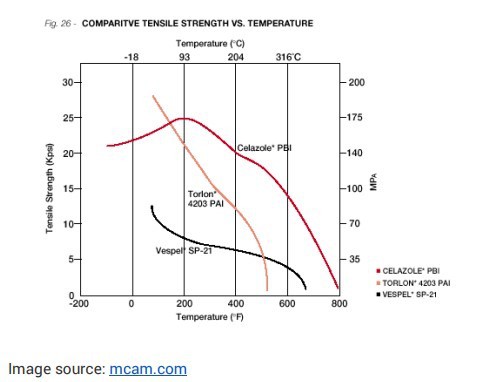
PBI has the highest mechanical properties of any polymer over 400°F (204°C). Compared to other performance polymers like Torlon® or PEEK®, it has the highest heat deflection temperature (HDT) at 800°F (427°C), with a continuous service capability of 750°F (399°C) in inert environments, or 650°F (343°C) in the air with short term exposure potential to 1,000°F (538°C).


Wear-Resistant Performance

Celazole® U-60 is an unfilled polymer suitable for injection molding or CNC machining into precision parts. When it comes to wear and abrasion, PBI has the highest compressive strength of all plastics. Its compressive strength is 57 kpsi and, its modulus strength reaches 850 kpsi compared to grades of Torlon® that start at 440 kpsi.


Celazole® can handle high loads at any speed and outperforms wear-grade PAI, PI, and PEEK® under similar conditions. Without additional lubrication, it runs 40-50F cooler than the competition.


PBI Grades

PBI comes in grades that can be extruded or melt processed, but in this brief we are covering grades of PBI that are CNC machined.


Duratron® PBI
Duratron® CU60 PBI is the highest-performance engineering thermoplastic available on the market. It has the highest heat resistance and mechanical property retention over 400°F of any unfilled plastic. It also offers better wear resistance and load-carrying capabilities at extreme temperatures than any other reinforced or unreinforced engineering plastic.


Although it is an unreinforced material, Duratron® CU60 PBI is very “clean” in terms of ionic impurity, and it does not outgas (except water vapor). These properties make this material very attractive to semiconductor manufacturers for vacuum chamber applications.


Other properties of Duratron® CU60 PBI include excellent ultrasonic transparency. This makes it a strong choice for delicate parts, like probe tip lenses in ultrasonic measuring equipment.


Duratron® PBI also serves very well as a thermal insulator. Other plastics melt and do not stick to it. For these reasons, it’s an ideal polymer for contact seals and insulator bushings in plastic production and molding equipment.


Celazole® PBI U-Series (U-60)
Celazole® U-Series has superior polymer strength with thermal stability. By itself, PBI can operate at continuous temperatures up to 1,004°F (540°C). As a resin incorporated into plastics, PBI features high heat and chemical resistance and good fatigue resistance, compressive strength, wear resistance, and electrical insulation.


Components made from Celazole® U-Series polymer perform well under conditions too severe for most plastics and outperform other materials like polyamide-imide (PAI) and polyetheretherketone (PEEK®) in many extreme environments.


Celazole® U-60 is an unfilled PBI polymer suitable for compression molding. It is often molded and machined into precision parts for industrial, chemical and petrochemical industries; aerospace, glass making, and liquid crystal display (LCD) panel manufacture.


Follow AIP Precision Machining on Linkedin

linkedin logo