PEEK’s Dominance in Medical Device Manufacturing
In the competitive landscape of medical device manufacturing, the choice of material plays a pivotal role in determining the quality, reliability, and safety of the end product. PEEK (polyetheretherketone) has emerged as an exceptionally promising alternative to traditional metals, presenting a slew of benefits that cater specifically to the unique demands of the medical field.
In particular, PEEK’s unique qualities make it a prime choice for medical applications where chemical resistance and exposure are prominent. Whether inside the body or in the operating room, PEEK provides biocompatibility, structural stability, and continuous mechanical functionality at high temperatures in critical environments.
Join us in our informational brief on why medical device manufacturers are increasingly seeking PEEK over metals for medical R&D applications.
Biocompatibility and Safety
PEEK excels in biocompatibility, a critical factor for medical devices, especially those that come into direct contact with the body. It has successfully cleared all ISO 10993 biocompatibility tests for both short and long-term implants. This ensures minimal risk of adverse reactions when used in vivo, eliminating concerns associated with metals, such as metallosis or allergic reactions.
 In a case study for reducing the need for brain surgery operations, PEEK became the top choice material for Dynamic Telescopic Craniotomy. Not only did this PEEK innovation provide biocompatibility with human tissue, it also expanded with brain swelling following a cranial surgery. This vital aspect of PEEK’s performance as a polymer highlights how it can advance brain surgery techniques and improve recovery times for patients.
Adaptable Design and Customization
PEEK’s inherent versatility supports a broad range of intricate and patient-specific designs. It can be CNC machined to create detailed medical devices or components with high precision. This adaptability is especially beneficial in the dynamic landscape of medical technology, where ongoing innovation and customization are paramount.
PEEK’s ability to perform with human tissue and fluids makes it an excellent choice for spinal implants, brain flap surgeries, and facio-skeletal restructuring. Research shows that medical grade PEEK material forms a solid structure while also providing malleability for complex shapes. Add biocompatibility and a low rate of infection to the list, and it’s no wonder that PEEK is a top pick in the medical industry for these intricate skeletal restructurings.
→ Read Now: “The Advantages of PEEK in Orthopedic and Spinal Fusion”
Chemical Resistance and Sterilization Ease
 In the medical world, devices often come into contact with a variety of chemicals, be it medications, sterilization agents, or bodily fluids. PEEK is chemically inert, resisting potential degradation or reactions that could compromise the device’s functionality or patient safety. Furthermore, PEEK devices can be sterilized using standard medical sterilization techniques without compromising the material’s integrity.
Advantages of PEEK’s chemical resistance
PEEK is relatively inert and biocompatible while also withstanding temperatures up to 100°C. Under the right circumstances, .005” – .020” ID tubing can be used up to 5000 psi for a limited time, and 0.030” to 3000 psi. Larger IDs are typically good to 500 psi. These limits are substantially reduced at elevated temperatures and in contact with some solvents or acids. Its mechanical properties allow PEEK to be used instead of stainless in many situations and in some environments where stainless would be too reactive.
However, PEEK can be somewhat absorptive of solvents and analytes, notably methylene chloride, DMSO, THF, and high concentrations of sulfuric and nitric acid. This tubing is highly prone to “kinking”, or sealing off, if held in a sharp bend over time.
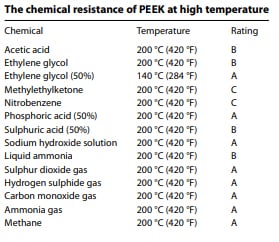 The chart at the right shows the chemical resistance of PEEK at 200°C (420°F). PEEK exhibits excellent resistance to a wide range of organic and inorganic chemicals. The compatibility of PEEK with many chemicals at 20 °C (68 °F) has been investigated and the results for unreinforced grades are favorable. PEEK is compatible with almost any of the solvents used in HPLC. The only solvent which will attack PEEK are concentrated nitric acid and sulfuric acids.
PEEK Performance and Innovation
The demands of the medical device industry are uniquely stringent, requiring materials that are safe, reliable, and adaptable. PEEK, with its remarkable blend of properties tailored to medical needs, has proven to be an invaluable choice for manufacturers. By integrating PEEK into their production, medical device manufacturers can ensure not only the longevity and reliability of their products but also the safety and well-being of the patients they serve.
Traditional metals such as titanium have a strong challenger in PEEK’s performance and innovation offering. It provides a combination of biocompatibility, chemical resistance and machinability that the medical industry demands.
While PEEK is a more expensive material, the benefits in long-term patient care and medical advancements can make a difference in ROI. When looking for a machinist to work with on your PEEK R&D project, consider one such as AIP with over 40 years of experience working with performance medical projects, FDA approved, and ISO 13485 compliant. Our facility only works with polymers, which is an important factor when machining any performance material. We promise to work with you from concept to completion of your project with the ability to turn around a prototype within 10 business days. Let our team go to work for you. Call us at 386.274.5335. Learn more about AIP’s medical industry capabilities and unrivaled PEEK results.
5 Advantages of PEEK Over Metals in the Pharma Industry
PEEK’s Superiority in Performance Engineering Applications
In the vast world of thermoplastics, PEEK (polyetheretherketone) stands out for its notable advantages over traditional metal fabrication. Especially within the pharma industry, where precision, reliability, and safety are paramount, PEEK has become the preferred choice for many applications.
Here’s why PEEK is gaining traction and gradually outclassing metals:
Enhanced Performance and Longevity
PEEK showcases a remarkable balance of durability and resilience, akin to metals. It operates efficiently at temperatures of up to 480°F and exhibits resistance to corrosion with a lower coefficient of friction. In dynamic pharma applications like centrifuge components or fluid seals, PEEK not only increases load capacity but also extends the service life. The outcome? Less frequent maintenance and prolonged, reliable performance.
High Purity and Biocompatibility
In the pharma world, material purity isn’t just a requirement; it’s the gold standard. PEEK’s inherent chemical structure ensures that it doesn’t react adversely with medications or other chemicals present in pharmaceutical processing. Variants of PEEK, such as Glass-Filled PEEK, PEEK-HT (High Temperature), and PEEK-UHP (Ultra-High Purity), are well-suited to replace metals in critical pharmaceutical applications, eliminating concerns like metallosis, which can be a problem with metal implants.
Lightweight Yet Durable
While the pharma industry might not be as weight-sensitive as aerospace, a reduction in component weight can lead to more streamlined and efficient machines. PEEK offers the robustness of metals but at a substantially reduced weight. This lightweight nature can contribute to reduced wear and tear, energy conservation, and overall better efficiency in pharmaceutical machinery.
Overall Reduction in System Cost
While the initial cost of PEEK might be higher compared to some metals, it’s essential to look beyond mere material costs. Given PEEK’s longevity, reduced maintenance needs, and its ability to lead to more efficient machinery, its value over time often surpasses that of metals. When considering the total system cost, including potential downtimes, repairs, and replacements, PEEK emerges as a cost-effective choice for the pharma industry.
In Conclusion
The pharmaceutical sector, with its rigorous standards and constant push for innovation, demands materials that can keep pace. PEEK, with its impressive array of properties, stands out as an exceptional alternative to metals. By partnering with industry experts like AIP Precision Machining, pharmaceutical companies can leverage the full potential of PEEK, ensuring that their products and machinery are not just cutting-edge but also reliable and cost-effective.

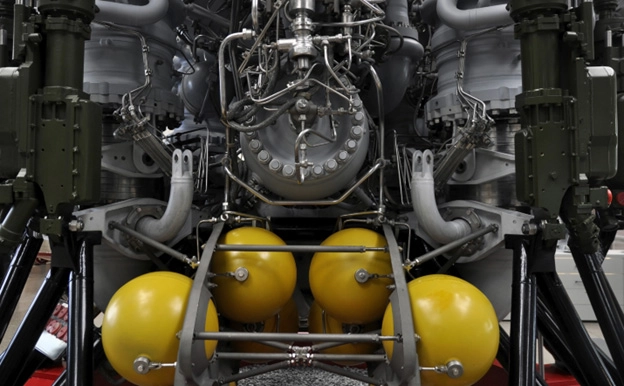
 One of the primary growth drivers for the aerospace parts manufacturing industry is the increasing demand for aircraft maintenance and replacement. As commercial airlines, military aircraft, and general aviation operations continue to expand, the need for high-quality, reliable aircraft components escalates. Furthermore, with aircraft often exposed to harsh environmental conditions, the need for regular maintenance and part replacement is paramount, ensuring operational safety and efficiency.
 Predictive maintenance, powered by big data and analytics, is transforming the aviation industry. By leveraging flight-recorded data, airlines can significantly reduce maintenance expenditures and enhance operational efficiency. This trend is creating unique growth opportunities for aerospace parts manufacturers, enabling them to meet evolving industry requirements.