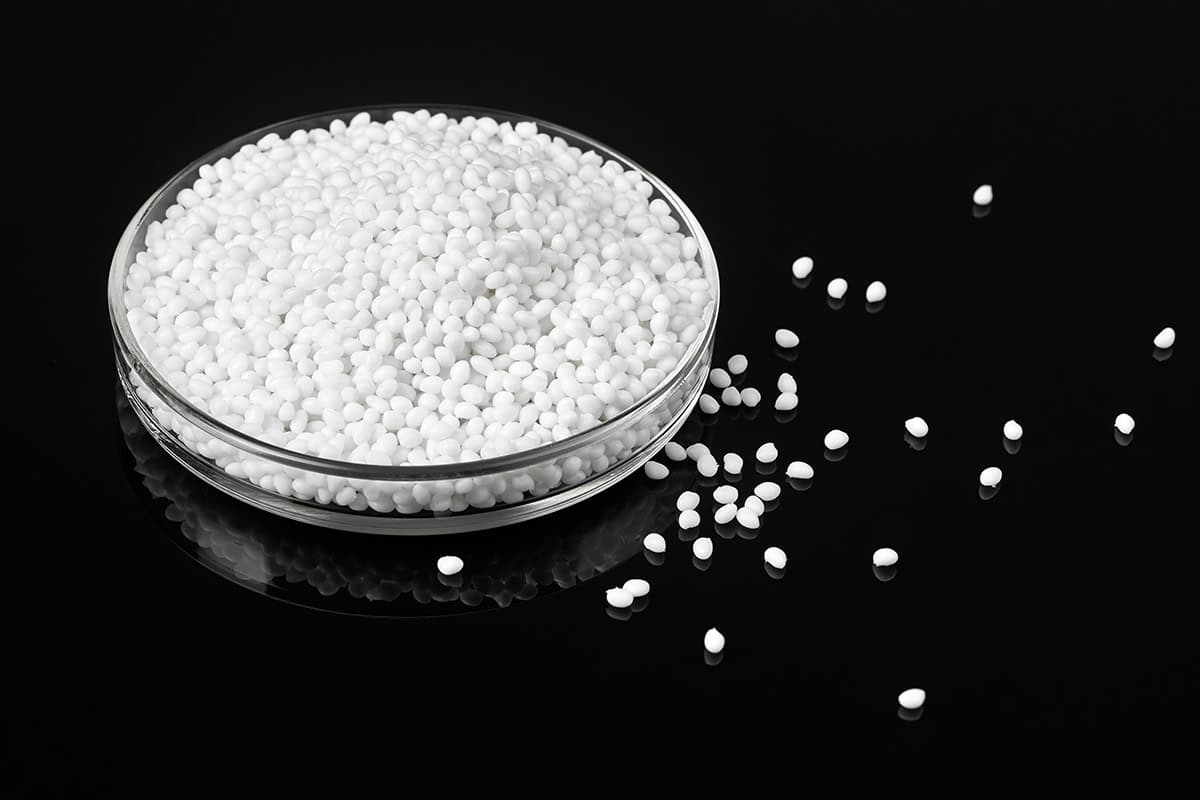
Glass transition temperature determines when a polymer changes from a rigid state to a semi-flexible state. The difference between Glass Transition Temperature and Melting Point in Thermoplastics shows how materials behave under varying temperature conditions.
Different polymers have substantially different glass transition temperatures (Tg). Polyetherimide (PEI) has a high Tg of 210°C, while High Density Polyethylene (HDPE)’s Tg sits at -120°C. The cooling rate affects this property – materials cooled faster show higher glass transition temperatures. Plastic melting temperatures vary widely too. Low-density polyethylene melts between 115-135°C, but high-performance polymers like PEEK can handle temperatures up to 343°C before melting. These thermal transitions affect mechanical properties such as tensile strength, impact resistance, and operational temperature range.
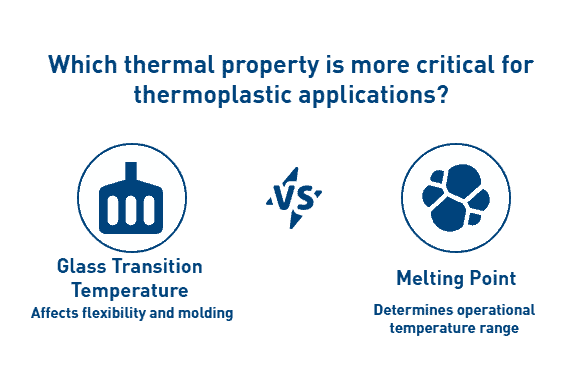
This article highlights the key differences between glass transition temperature and melting point. Engineers can see how these properties shape material selection, thermal performance, and manufacturing precision. The concepts help professionals in aerospace, medical, and semiconductor fields to optimize component design, processing methods, and performance in challenging environments.
Understanding Glass Transition Temperature (Tg)
The glass transition temperature (Tg) is a basic thermal property that sets polymer behavior apart from regular materials. Unlike metals or simple compounds, polymers don’t have a clear-cut melting point between solid and liquid states.
What is glass transition temperature of polymers
Glass transition temperature shows a reversible change that happens in amorphous polymers. The material changes from hard and brittle to soft and rubbery. This temperature tells us the point where polymer chains get enough heat energy. They break free from the forces that held them in place.
The molecular view shows Tg as the temperature where polymer chains start moving past each other. Nothing changes in the material’s structure, but its mechanical properties change dramatically. The properties don’t change suddenly – they change bit by bit as polymer chains slowly break free.
Tg vs Tm: Key thermal behavior differences
Glass transition temperature and melting point are two very different thermal behaviors. Tg shows what happens in amorphous regions, while melting point (Tm) relates to crystalline regions.
Semi-crystalline thermoplastics show both changes separately. The amorphous parts soften first at Tg. Later, the crystalline regions melt at Tm. Engineers call the space between these temperatures the “rubbery region”. A polymer’s Tm always stays higher than its Tg.
Thermal analysis makes this difference clear. Tg appears as a heat capacity change (second-order transition). Tm shows up as an endothermic peak that needs lots of heat (first-order transition).
How Tg affects polymer flexibility and brittleness
Glass transition temperature changes how polymers behave mechanically. Below Tg, polymers show:
- High stiffness and brittleness with limited chain mobility
- Primary elastic deformation with minimal plastic deformation
- Greater resistance to creep and stress relaxation
Above Tg, polymers show:
- Less stiffness with rubber-like flexibility
- Viscoelastic deformation with significant plastic components
- More creep under load
These property changes make Tg vital for picking the right material. Engineers need to know if their project needs a polymer’s stability below Tg or its flexibility above it. That’s why learning about both Tg and Tm helps predict how materials will work at different temperatures.
Melting Point (Tm) and Crystalline Behavior
The melting point (Tm) marks a key temperature where crystalline regions in polymers change their phase. This process is different from glass transition because it changes the material’s physical state instead of just affecting chain mobility.
What is melting point for plastic and how it is different from Tg
The melting point of plastic is the exact temperature where a solid thermoplastic material changes from solid to liquid. The polymer chains start moving freely when the intermolecular forces holding them together become weak. Tm shows a first-order phase transition that creates sudden changes in physical properties.
Melting point works differently than Tg. It affects only crystalline structures while Tg impacts amorphous regions. Crystalline plastics show clear melting points and stay rigid until they reach this specific temperature. Semi-crystalline polymers always have a Tm that’s higher than Tg. Many polymers follow a pattern where Tm≈1.5Tg (in Kelvin).
Phase change in semi-crystalline polymers at Tm
Semi-crystalline polymers have both ordered crystalline regions and disordered amorphous zones. These polymers experience Tg in amorphous regions and Tm in crystalline regions as separate thermal events. The orderly crystalline structure changes into a disordered, viscous state at the melting point.
Several molecular factors affect how polymers melt. Materials with higher molecular weight need more heat to melt because their intermolecular forces are stronger. Crystalline structures also need higher temperatures to melt than amorphous materials due to their ordered arrangement.
Heat absorption and molecular mobility at Tm
Polymers absorb a lot of heat energy without getting hotter during melting—a key sign of first-order phase transitions. The material’s temperature stays the same while this energy breaks down the crystal lattice throughout the melting process.
The molecular level shows dramatic changes in mobility:
- Polymer chains break free from crystalline formations and slide past each other
- Secondary bonds between chains break completely instead of just getting weaker
- Chain segments stop vibrating in fixed spots and move independently
Scientists can study what happens at Tm through phonon conduction processes and by measuring changes in specific heat and elasticity modulus with temperature. Engineers use this knowledge to pick the right materials that can handle heat while supporting weight.
Amorphous vs Semi-Crystalline Thermoplastics
Molecular structure shapes how thermoplastics react to temperature changes. This creates distinct behavior patterns that engineers need to think about when they choose materials for precision applications.
Structural differences: Random vs ordered molecular chains
Picture a plate of cooked spaghetti – that’s what amorphous polymers look like at molecular level. Their molecules have no specific pattern, which lets light pass through and creates transparent materials. Semi-crystalline polymers are different. They have highly ordered regions where polymer chains pack tightly in regular patterns next to amorphous zones. These materials’ organized structure creates stronger forces between molecules and leads to better mechanical strength.
Which polymers exhibit Tg only vs both Tg and Tm
Amorphous polymers show only a glass transition temperature (Tg) and don’t have a true melting point. These materials get softer as temperature rises instead of melting sharply. They are great at maintaining their dimensions and barely shrink. Semi-crystalline polymers, on the other hand, show both Tg and Tm behavior. They stay rigid until they hit their melting point, then turn into low-viscosity liquids faster than you’d expect. This makes them valuable, especially when you have specific thermal performance needs.
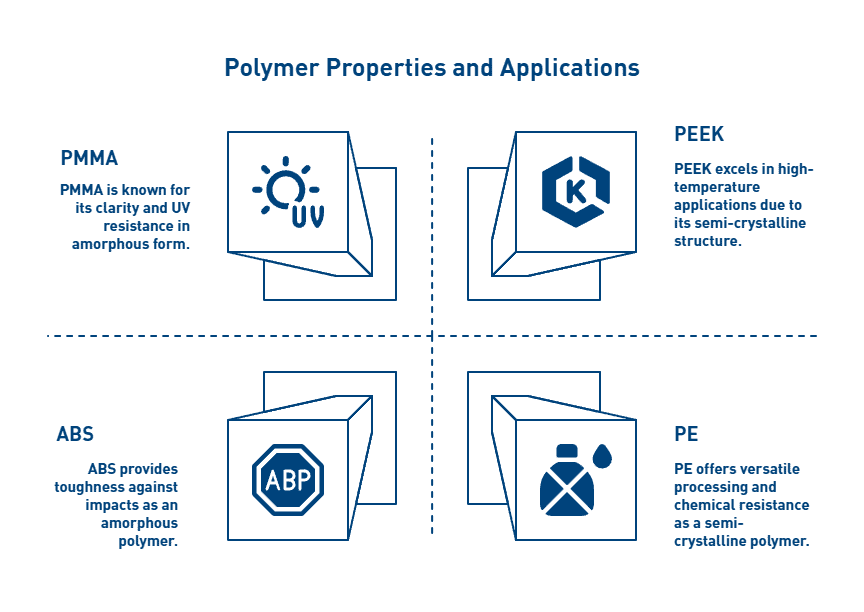
Examples: Polystyrene, Polycarbonate, PEEK, PTFE
You’ll find these common amorphous polymers:
- Polystyrene (PS) and Polycarbonate (PC) – see-through with excellent dimensional stability
- Polymethyl methacrylate (PMMA) – known for clarity and UV resistance
- Acrylonitrile butadiene styrene (ABS) – tough against impacts
The standout semi-crystalline polymers are:
- Polyetheretherketone (PEEK) – handles high temperatures up to 250°C
- Polytetrafluoroethylene (PTFE) – resists chemicals and self-lubricates
- Polyethylene (PE) and Polypropylene (PP) – resist chemicals well and are versatile to process
Semi-crystalline polymers beat amorphous materials at wear resistance, chemical resistance, and load-bearing tasks. Amorphous polymers shine better at absorbing impacts and keeping their shape.
Why Thermoplastic Engineers Need Both Tg and Tm
Glass transition temperature (Tg) and melting point (Tm) are the foundations of successful application development that thermoplastic engineers must understand. These thermal properties serve as the life-blood of material selection decisions that affect product performance directly.
Material selection based on Tg or Tm
Engineers must assess whether their application’s operating temperature will exceed a polymer’s Tg or reach its Tm. Polymers stay hard and brittle below Tg, yet become soft and flexible above it. Semi-crystalline polymers with suitable Tm values deliver better performance when applications need rigidity at high temperatures because crystalline regions stay intact until reaching melting point.
Material selection criteria typically include:
- Operating temperature range versus polymer’s Tg and Tm
- Required mechanical properties at service temperature
- Processing temperature constraints
- Dimensional stability requirements
Tg and dimensional stability in high-precision parts
Dimensional stability through thermal transitions plays a vital role in high-precision components. Amorphous regions soften above Tg, which might compromise part geometry. Semi-crystalline thermoplastics show remarkable dimensional stability and minimal warpage after thermal cycling. Their unique molecular structure creates this stability – crystal regions provide rigidity and strength while reducing thermal expansion.
High-precision component designers must think over how repeated thermal cycling affects dimensional stability. Explore how AIP’s precision machining ensures dimensional stability through Tg and Tm transitions – request a consultation today.
Tm and thermal endurance in load-bearing applications
Tm sets the ultimate thermal endurance limits for structural components at elevated temperatures. Semi-crystalline polymers keep substantial structural integrity above Tg but below Tm as crystalline regions stay unaffected until melting. This characteristic offers a great way to get stable mechanical properties under thermal stress in load-bearing applications.
Case study: ULTEM™ vs PEEK in aerospace components
ULTEM™ and PEEK comparison shows why both Tg and Tm matter substantially. ULTEM™, an amorphous polymer, has a higher Tg (217°C) than PEEK (143°C). All the same, PEEK’s semi-crystalline structure allows continuous use at temperatures up to 260°C, this is a big deal as it means that ULTEM™’s 171°C limit.
This difference proves significant in aerospace applications. ULTEM™ shines in electrical components due to its superior dielectric strength (830 V/mil versus PEEK’s 480 V/mil). PEEK leads in structural components near heat sources, offering better chemical resistance and wear properties despite its triple cost.
Conclusion
Engineers need to know the basic differences between glass transition temperature and melting point to select the right thermoplastic. Tg shows when amorphous regions change from rigid to flexible states. Tm indicates the point where crystalline structures completely break down. These thermal transitions affect material performance in applications of all types.
Thermoplastic engineers should think about both properties when they design components for tough environments. Semi-crystalline polymers stay structurally sound above Tg but below Tm, which makes them work better in high-temperature uses. Amorphous materials give better dimensional stability and optical clarity but don’t handle heat as well. This difference matters a lot for precision components that go through temperature cycles that could affect tolerances.
The case study of ULTEM™ and PEEK shows how understanding Tg and Tm helps choose materials for specific uses. PEEK works better for structural parts near heat sources because it handles higher continuous temperatures, even though ULTEM™ has a higher glass transition temperature. These subtle differences show why simple material selection often fails in demanding situations.
Precision manufacturers must factor these thermal properties into their process. Molding temperatures, cooling rates, and post-processing treatments change crystallinity levels and mechanical properties. Engineers who utilize this knowledge can design parts that stay stable across their working temperature range.
Glass transition temperature and melting point work together instead of competing. They give engineers a complete way to predict how thermoplastics behave under heat stress. Engineers who become skilled at both concepts make better material choices that lead to more reliable thermoplastic components for aerospace, medical, and semiconductor uses.
For engineers specifying materials in critical applications, understanding both glass transition temperature and melting point is essential—but selecting the right polymer is only part of the equation. Achieving precision in high-performance components also depends on expert machining that accounts for these thermal transitions. Explore how AIP Precision Machining ensures dimensional stability through Tg and Tm transitions—request a consultation with our team today.
FAQs
Q1. What is the main difference between glass transition temperature and melting point? Glass transition temperature (Tg) marks when amorphous regions in polymers transition from rigid to flexible, while melting point (Tm) is when crystalline regions completely break down. Tg affects chain mobility, while Tm fundamentally alters the material’s physical state.
Q2. How do amorphous and semi-crystalline thermoplastics differ in their thermal behavior? Amorphous thermoplastics only exhibit a glass transition temperature, gradually softening as temperature increases. Semi-crystalline thermoplastics demonstrate both Tg and Tm, remaining rigid until reaching their melting point, where they rapidly transform into low-viscosity liquids.
Q3. Why is understanding both Tg and Tm important for thermoplastic engineers? Knowledge of both properties is crucial for material selection, as they determine a polymer’s behavior across different temperature ranges. This understanding helps engineers predict performance in various applications, from high-precision parts requiring dimensional stability to load-bearing components needing thermal endurance.
Q4. How does the glass transition temperature affect polymer properties? Below Tg, polymers are hard and brittle with high stiffness. Above Tg, they become softer and more flexible, with increased susceptibility to creep under load. This transition significantly impacts mechanical behavior and dimensional stability.
Q5. Can you provide an example of how Tg and Tm influence material selection in aerospace applications? In aerospace, ULTEM™ (amorphous) and PEEK (semi-crystalline) illustrate the importance of understanding both Tg and Tm. While ULTEM™ has a higher Tg, PEEK’s semi-crystalline structure allows for higher continuous use temperatures, making it preferable for structural components near heat sources despite its higher cost.